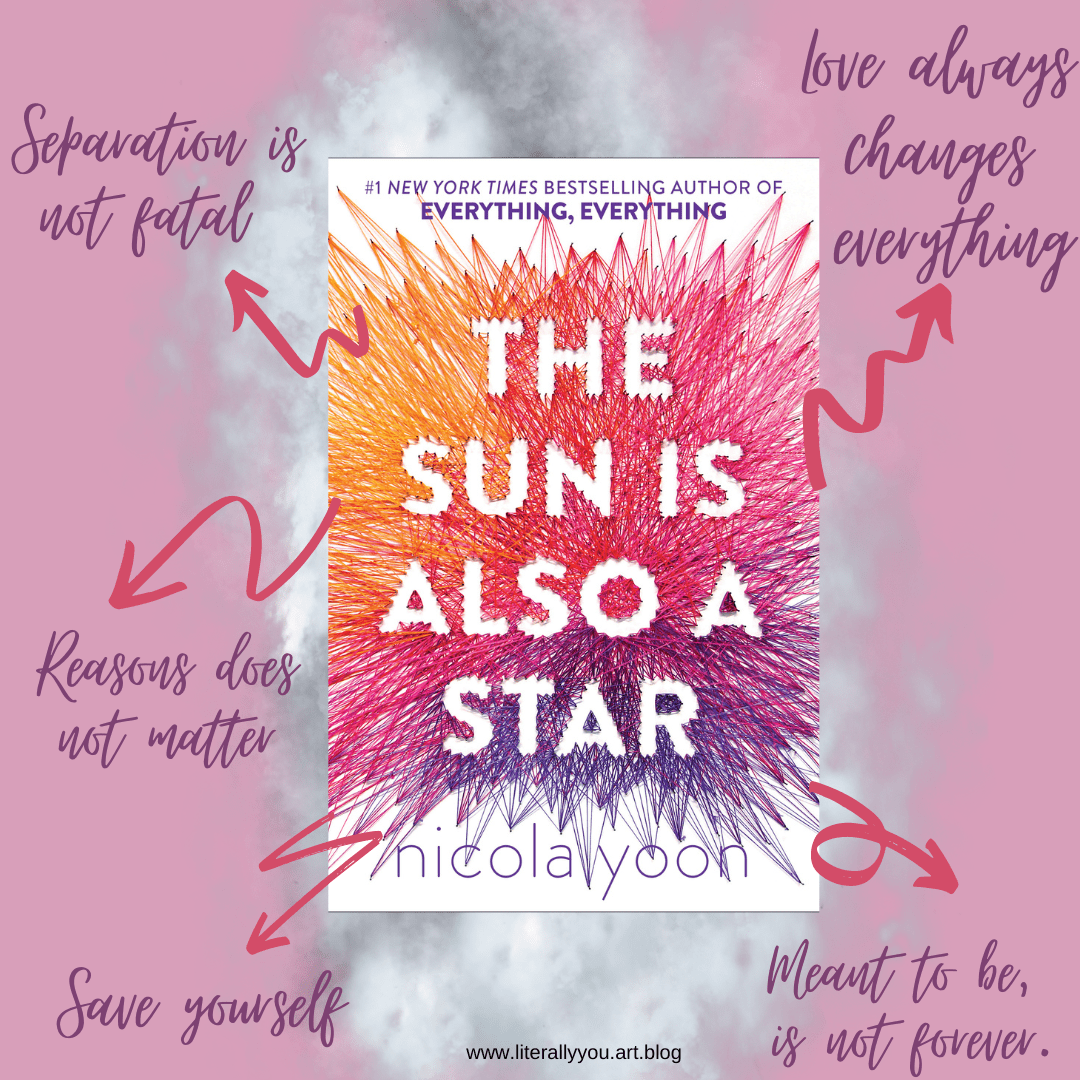
“Stars are important,” but why not more poems about the sun? The sun is also a star. and it’s our most important one. That alone should be worth a poem or two.”
NATASHA, who believes in science and facts. Not fate. Not destiny. No dreams of falling in love with a cute boy on a crowded New York City street. DANIEL, a poetic, dreamer soul. Seeing Natasha makes him think that fate has something much more extraordinary in store – for both. THE UNIVERSE, Every version of our past and future histories exist, just in an alternate universe. An infinite number of universes exist in which you made a different choice. In this way, we get to live multiple lives. Which one will come true?
Their story is with no big history. They met. Fell in love. Got an insight into their connection, all happened on the same day. The day before Natasha was expected to be deported from America to Jamaica. The story narrated by the universe revolves around two extremely passionate adults embarking on their journey centered on love, time, and fate.
Nicola Yoon, the author has a beautiful expressive mode of acknowledging love. An intense question-answering session. Passionate observant facts of the characters against the universal facts. And, quoted some captivating writings.
It does no harm to the romance of the sunset to know a little about it.
– Carl Sagan
Despite pretending her best. Overlooking the connection. All due to the unavoidable circumstances of her deportation. There comes a time Natasha admits to herself that ‘she now desires to make Daniel happy.’ She still believed that there is nothing like magic. Here, the universe’s observant fact enters to clarify “we are magic”. (Any of our undesirable situations cannot prevail when the universe’s magic through us could prevail literally anywhere anyhow.)
The most impressive part. Natasha observes that Daniel fell in love with her out of his subconscious, which was looking for someone to save him from his passionate yet factually impractical and indecisive beliefs. And, Natasha directs him the way, gives him space, and says, “SAVE YOURSELF”.
“You can’t make a home out of human beings someone should have told you that.”
– Warsan Shire
In the very first intense observation; Natasha found Daniel perfectly silly, too optimistic, too earnest, and pretty good at making her laugh. Whereas, Daniel states Natasha; doesn’t realize how passionate she is about not being passionate. She’s definitely not a fan of certainty. And, waves off Daniel’s take on doing a lot at once as his indecisiveness to choose.
The realization begins with Daniel getting knocked down with a self-reflection of gathering courage. Not going for an easy thing. Rather, not the right thing. A want to fall in love. With an emphasis on falling apart. Moreover, Natasha willingly wants to be proven wrong. Wrong, for not believing in God or true love. Desperately wanting him to choose her. (The most beautiful part of a relationship is to put off your egoistic and stubborn presumptions. Somewhere deep down there comes a time when a connection makes us feel weak in our knees, we are ready to put our self-respect the stake of receiving that blessing we always doubt receiving)
Daniel’s optimism sounds like, ‘you can love someone and still have a not-so-great relationship with them.’ However, Natasha’s pessimism tolls on, ‘It’s hard to love someone who does not love you back’. (Yes, it only “sounds” the way it’s been presented. In fact, it’s the otherwise while dealing with it. You can not love someone with not-so-great relationship. And, why to love someone who doesn’t intent to revert back.)
The book overflows with fluctuating human perspectives at different times with diverse mindsets. This makes reader’s experience remarkably authentic. We human accept and evolve whatever it takes to survive. In this way, we get to live multiple lives (as Nicola says).
We are here to evolve and survive.
Toward the end, it is not a visual thing that could once be seen and remain with us forever. It’s a book, here being a reader I seek more words, expressions, and feel to the end part. When ultimately they meet in an uncertain situation after that long time span. Till then they almost realized that ‘time and distance are lovers’ natural enemies’, making them feel like eventually forgetting each other. The ending seems incomplete(in words). Fortunately, it is a happy ending.
RECOMMENDATION: Read, if you believe everything is written in the stars. Find, ‘time and distance to be lovers’ big factors but not more than the universe’s divine timing.’
It is the most recent read from my shelf and most probably the first ever if I had to consider the dedication of the authors to stick to the storyline. Nowhere it felt like the authors are showcasing their writing skills through nonrequired exaggerated situations. And, who said fancy lines are the only writing skill to satisfy the curiosity of the reader, to meet the expectation with which they pick the book?
WHY I CHOOSE TO READ IT?
Being on the verge of surrendering control and letting literally everything happen at its own pace, with every passing day I feel more inclined towards trusting the Universe’s right timing for the right person to enter my life. Moreover, I have recently (read somewhere) acknowledged the fact that you could have more than one soulmate, it’s not about your life partner, counterpart, or that special one. And, it’s been said by River as well in the book:
Compatibility is not limited to just romantic relationship
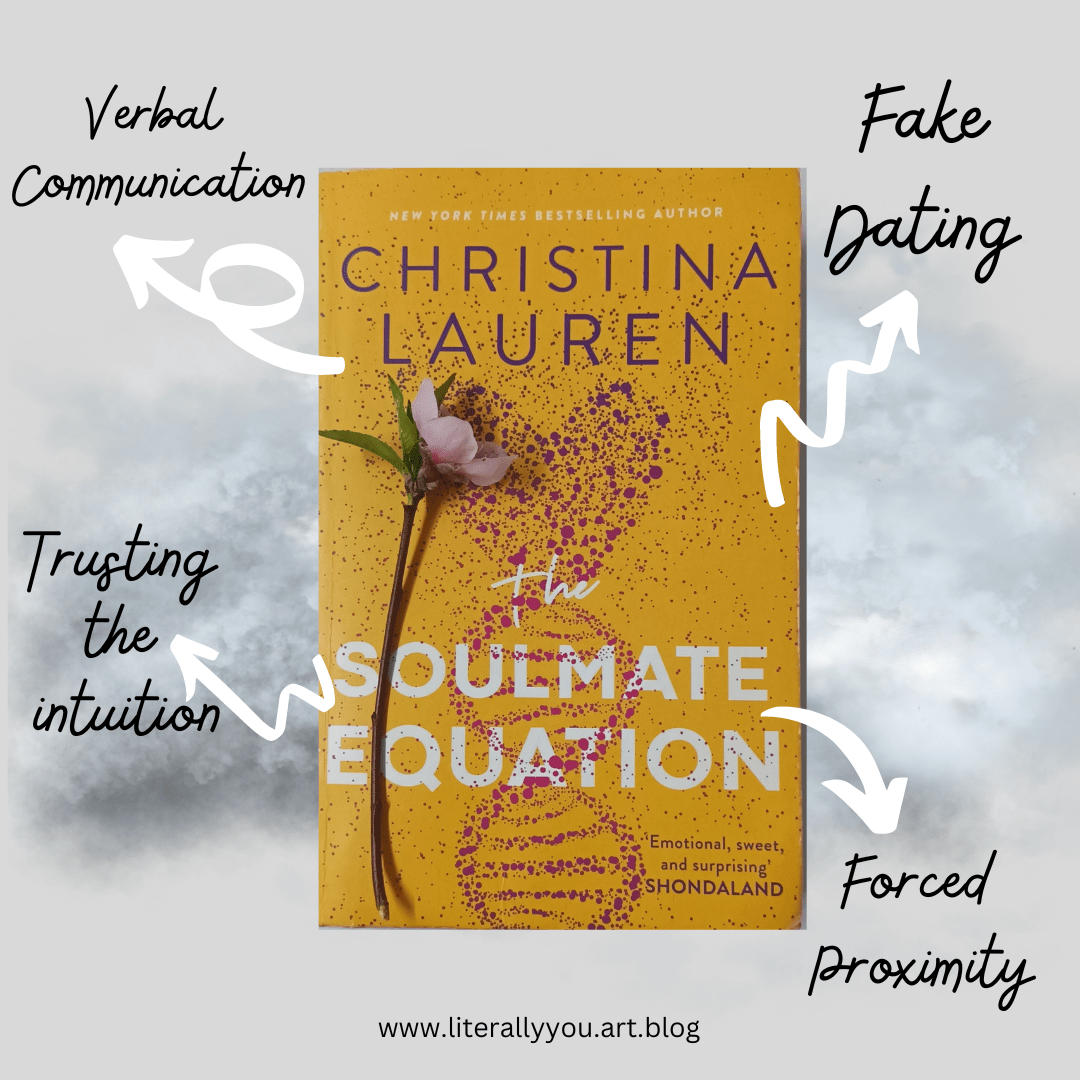
Jessica Davis with a non-existent love life went through yet another date ending in disaster. She was preparing to give up on love for good when she heard about GeneticAlly, a buzzy new matchmaking company that claims to find you your soulmate using a DNA equation. Suddenly, love doesn’t seem quite so far out of reach.
Dr. River Pena, founder of GeneticAlly matches the compatibility of Jess on her test with an unheard score of 98.
At first, it felt like having an unequivocal desire to have a likewise application available to know; – who suits you the most at that higher level? or – whom you choose stands exactly there, where you expect it to be?
With every next page, it was so satisfying to realize to not know where the connection stands on paper (according to statistics) but to know where the counterpart had made the connection stand within them.
After the main leads of the story, the DNADuo score caught most of the attention. DNADuo score, certified, scientifically where the compatibility as soulmate lies with the other. (Dissatisfied to read that towards the end one (Dr. River) knows their DNADuo score and the other person (Jessica) doesn’t.)
(Here I realized I was looking forward to such an application may be because I was seeking confirmation in the reaction of both of them towards the company’s Diamond match score of 98 – which later on was revealed to be forged by Dr. River’s company marketing team to hike the attention of the audience towards the application.)
There comes a time when you need to be sure of your feelings.
After knowing the forged score scale, River went silent for a long when Jessica had to remind herself that ‘she was still better off than she had been before all this craziness began.’
Jessica is undoubtedly correct here. Reminding yourself this (‘she was still better off than she had been before all this craziness began‘) is the best resort you should opt for when situations and feelings go out of control or start working otherwise. Else, you would never be able to open yourself to the story’s other side, like when Jessica and River had a heartfelt conversation and Jessica got to learn that River was depressed due to; the family like colleagues ditching him and always felt Jessica near her ever during physical distance, hell silence, and emotional disconnect.
My curiosity to look for some app. like this settled when I read Jessica saying River, “Statistics can’t tell us what will happen, they can only tell us what might happen.”
Jessica being the one initially feeling comparatively unsure about the equation towards the end, realized that: “destiny could also be a choice, to believe or not, to be vulnerable or not, to go all in or not.” (And, this was the only fact certifying River’s unexpected admission in Jessica’s life, Jessica unwillingly falling for him, and ultimately wanting him to stay forever despite the disclosure of the 98 scores of DNA being falsified.)
“Good things” happen to us like “opportunities” anyhow as destined. The thing is that as soon as we believe in it, it hampers the time of our suffering. As long as the vulnerability in our thoughts of what we deserve against what we are receiving better settles, we become open to our blessings soon without judging our capabilities. Moreover, we could honor our destiny by surrounding ourselves to its fullest worth by believing that what so ever is happening is in our best interest and that ‘what so ever’ is not as per our willingness will be surely a detour to something better.
RECOMMENDATION: Read if you are at that stage of your life when you need to be sure of your feelings with sheer verbal communication.
This is another question of the 365-day challenge. After replying to these 365 questions on soul-searching, you would undoubtedly come out decisive, confident, and much more hopeful with yourself than ever before. And, I will help you to know yourself more every single day for the next 365 days.
WHAT IS SOUL-SEARCHING?
What does “soul-searching” accomplishes? Where do you end up with it? It is digging deep and focusing on oneself to lead a contented life. Because soul-searching could create a visualization of your much achievable future by giving you an insight into what one is today, in the present.
“A situation does not attract any misfortune of life. It’s the way you perceive the solution does.” And this is where “soul-searching” backs you.
ANSWER THIS #68 QUESTION
#68 question How do you look when you visualize yourself as a physically fit person?
Know! The intention, which could keep you from falling for an unhealthy diet.
“Visualization becomes reality when you hook intention to your desires.”
-Farheen Dhanjal
How to be intentional with your life?
Desire is a thing that makes you think that what you are doing in your life, the things that you have in your life, are going to help you or hurt you towards anything you are trying to build.
And it all comes down to one thing, to be intentional with your life. Many among us are living our life being asleep, being unconscious. Most of the time, we are unaware of the stuff that’s going on in our life, what’s serving us and what is not.
Have you ever sat down and thought about all of the things that you do; have you thought of when you are waking, what you are going on priority, why are you eating what you are eating, moreover the people you surround yourself.
It’s an awakening process because if you get intentional with your life, you would realize that there are a lot of things that you do are good, and many more that would make you think that: -why the hell I am still doing it, -why I’m still talking to this person, -why I’m not taking care of myself.
Top 7 Quotes on being intentional
“An unintentional life accepts everything and does nothing. An intentional life embraces only the things that will add to the mission of significance.”
– John C Maxwell
“You can have anything you want, if you want it badly enough.”
– Abraham Lincoln
“The key is not to prioritize your schedule but to schedule your priorities.”
– Steven Covey
“You can go slow. Allow your dreams and goals to change, but live an intentional life.”
– Kumail Nanjian
“The power of intention is the power to manifest, to create, to live a life of unlimited abundance, and to attract into your life the right people at the right moments.”
– Wayne Dyer
“To the degree, we’re not living our dreams; our comfort zone has more control of us than we have over ourselves.”
– Peter Williams
“If you don’t go after what you want, you’ll never have it. If you don’t ask, the answer is always no. If you don’t step forward, you’re always in the same place.”
– Peter Williams
CONTENTS OF THE QUESTION
Each question would consist of 3 parts: Part 1: QUESTION – It would determine the path of knowing you as an individual.
Part 2: KNOW – It would let you know what you learned about yourself.
Part 3: QUOTE – It would depict the righteous approach to the concept being asked in the question.
HOW TO PRACTICE THIS ACTIVITY?
You just have to reply to Part 1, and just read, learn and reflect on Parts 2 and 3.
Grab a pen & paper and start writing your reply. Remember! Nothing is tough when it comes to doing it for yourself. And, you just need to be truthful to yourself.
Feel free to share.
Happy “soul-searching”
Download for free this wall art printable of high-quality Pdf—16×20 in.
Generally, people praise the optimistic mindset, and research suggests that optimism helps. We reduce stress and depressive symptoms. Hence, optimism seems to be a healthy coping mechanism for dealing with the future when looking at the scientifically proven benefits.
But, does optimism also have downsides? Can some forms of optimism even be dangerous? And could it be that, in some cases, we’re better off being pessimistic? This blog explores why optimism may not always be the wisest choice and why being a pessimist may be the best move.
There are different definitions of optimism. The Cambridge Dictionary, for example, describes optimism as: “The quality of being full of hope and emphasizing the good parts of a situation, or a belief that something good will happen.” The Collins Dictionary defines optimism as: “the feeling of being hopeful about the future or the success of something in particular.” And Oxford Languages provides the following definition: “Hopefulness and confidence about the future or the success of something.”
In my opinion, optimism doesn’t mean “emphasizing the good parts of a situation” (or “seeing the silver lining”). Rather, optimism refers to hopefulness and confidence about the future and the belief that something good will happen.
Pessimism isn’t just about negative thinking. Personality science has revealed it also includes a focus on outcomes – that is what you expect will happen in the future. While optimists expect positive outcomes will happen more often than not, pessimists expect negative outcomes are more likely.https://theconversation.com/the-surprising-benefits-of-being-a-pessimist-91851
Optimistic future predictions can make us feel good in the present, but that doesn’t mean they’re trustworthy or helpful in dealing with future events. There’s always a chance that everything will not be okay, and things will not work out fine. And if that happens, chances are we’re not just disappointed but also unprepared. Moreover, there’s no reason to be optimistic in some situations. But if we nonetheless insist, optimism quickly turns into denialism and toxic positivity.
Listen to the podcast to know why in order to be productive (as in here, optimistic) we go wrong.
Productivity is too good to be true. And, this idea came from a simple idea that more of a good thing is better. But we forget that the further we go down the rabbit hole the less innocent things become. #1: Productivity generates conditional self-love #2: Productivity pushes you to achieve what other people achieve #3: Productivity distracts your competition with the world out there #4: Productivity makes you selfish #5: Productivity is more focused on results.
Now, let’s explore some reasons not to be optimistic
(1) You won’t be shocked by the repercussions
Suppose we’re optimistic about the future. in a way that denies the possibility of significant adversity (especially when things are looking grim). In that case, we’ll be shocked, dumbfounded, and overwhelmed when Fate surprises us by presenting what we deem impossible.
This logic applies to all forms of misfortune. A company’s best employee can still lose her job. The richest man in the world can still lose all of his wealth, the most stable and happy marriage can still fall apart, and someone with the healthiest lifestyle imaginable can still die from a heart attack anytime.
Impermanence is the only constant, always at work, creating and destroying and making things we deem impossible possible. And when those things occur, many people are devastated, which they probably wouldn’t have been if they were open to the possibility of the worst happening.
Instead, they would have prepared themselves. And so, a degree of reasonable pessimism is probably our best bet, as opposed to sticking our heads in the sand like ostriches ‘optimistically’ pretending that everything will be fine.
(2) You use the situation advantageously
We could call it ‘denialism’ or ‘baseless optimism’. An empty optimism, often based on rumours, isn’t the correct answer to our terrible mental health. The yearning for liberation, disappointments about the future, and unwillingness to work with the present proves fatal.
Regardless of how unfortunate, accepting our current situation grants us the opportunity to find meaning in those circumstances. And so, we’re able to use the situation to our advantage, for example, as a means of growing personally or strengthening our resilience.
We could also use our circumstances to benefit other people, for instance, by helping those struck by a similar tragic fate.
How, to pose the question differently, can life retain its potential meaning despite its tragic aspects? After all, “saying yes to life despite everything,” to use the phrase in which the title of a German book that life is potentially meaningful under any conditions, even those which are most miserable.
(3) You appreciate, positive outcomes
So, while optimism may be pleasurable in the short-term, pessimism could secure an overall better experience in the future, as negative but reasonable expectations may prepare us better for any fate. Also, baseless optimism can be pretty dangerous, generating false hopes for the future and grave (even deadly) disappointment.
Just give a pause and think, of you are already determined about the best possible results out there to work out for you like a blessing obliged to you. How would you promote celebrating the achievement of real success? Not only you would find it hard to express the pleasure of accomplishment, but also you would certainly remain unaware of the feeling of self-satisfaction and fulfilment. And, fulfilment is something, without which you could never justify the meaning of happiness for yourself.
Moreover, with a picture-perfect kind of success in the back of the mind, no one could be mindful enough to appreciate the success you tend to receive. Because, with the particularly appreciative of the outcome; p simply got what he expected, nothing more, nothing less.
Positive thinking had been perceived incorrectly a lot of times. The faith surrounding the idea of thinking positive is somehow failing. Unfortunately, everyone had begun to adopt the habit of optimism to ignore the reality of their life. Excessive positive thinking is putting the optimum in a box.
DOWNLOAD THIS WALL ART PRINTABLE TO UPLIFT THE VIBE IN YOUR SURROUNDNGS
Some would say you are godly like heaven, while others would say, you are vicious like venom.
You don’t need to be the right or don’t even try to be the right person for anyone. Because in the very beginning it’s your credibility that makes you matter something to someone and in the end also it’s only the credibility of a person that matters.
Be someone that the one who loses you says,’ they missed out on their fate’ and the one who earns you says, ‘you are worth the wait.’
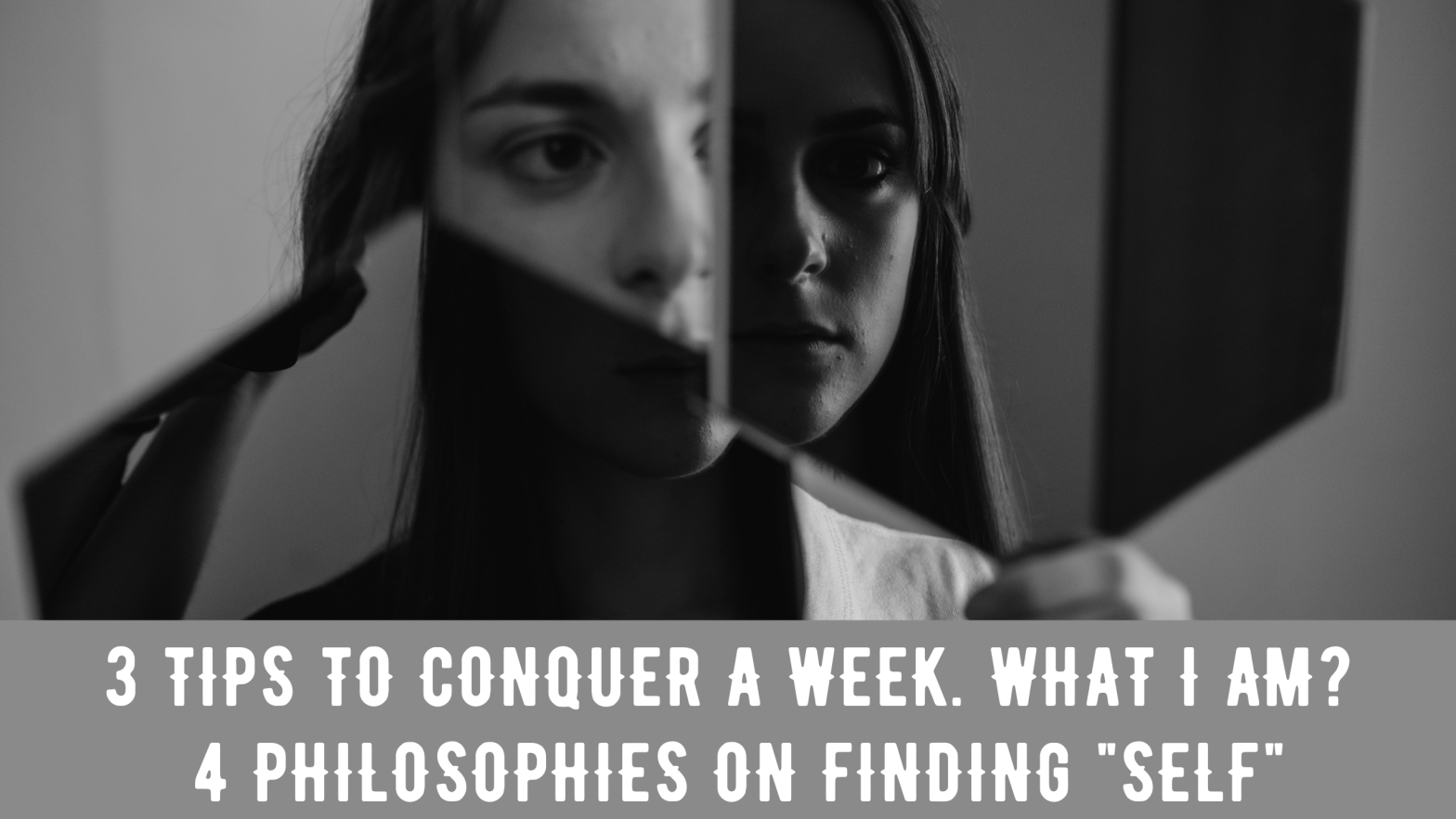
Dedicate your one week to know which philosophy does you follow. then, you ready to search yourself, which is a life long process.
3 Philosophies on finding “self”
I. “Self” is individuality
We feel that we must differentiate ourselves from others, endlessly. We have a model of self where the self is kind of like an avocado. We have a pit inside of us.
The pit is our self, our essence, our identity. It is the thing to which we must above all be true. And of course, very importantly, we see that pit as unique. So that everything we do we want to show to reflect that pit, to reflect that self. And we want it to be unique through exercising our rights.
Where some other people frequently have a flexible self, whereas it’s a different kind of self. It is a self that’s oriented more to duty than to rights, for instance. And very importantly, it is not, it does not have a cultural mandate to be different and to be unique. So if you ask, are they individuals? Of course, they’re individuals.
Are they different? Of course, they are different. But of course, for them, it’s like, well I’m different, why would make a big deal of that, right? The difference is, how much significance do we attach to that difference? In other words, do we think it’s very important to differentiate ourselves from others? So one of the ways that we do that, of course, is through choice.
When we had to serve our elders somebody from a more flexible-self, or interdependent culture, would say, it’s just your duty. And so for them, it’s like, they help their elderly parent. They just go take care of the elderly parent because that’s their duty. For them, this is really liberating. You just go do it and you don’t expect it to be an expression of yourself. It’s just what people do. From their point of view, we have made things very, very hard for ourselves to demand that everything should be an expression of inner nature.
II. “self” is an authenticity
We often like to think that the way to become a good person is to look within and find one’s true self, the sort of natural self that we have. And once you’ve found that self, that natural thing that you are, the goal is to be sincere and authentic to that true self.
So if we stick to what we naturally are meant to be, the gifts that we’re naturally endowed with, that’s how we can be a sincere, authentic person would say, that sounds good but is on the contrary extremely restraining-and constraining to what we could do.
The fact is, if we’re messy creatures, as many of them would say, what we perhaps are in our daily lives are simply people whose emotions are being pulled out all the time, by people we encounter. And over time, those responses fall into kind of ruts and patterns that can just be repeated.
And if ‘being the one who you already are’ is the goal, you should be trying to break those patterns, alter those patterns, and change the way you interact in the world. And if you’re simply saying, should be who I naturally am meant to be, well, what you’re probably doing is simply continuing to follow a bunch of patterns, probably destructive to yourself, and almost assuredly destructive to those around you. The idea is constant work working through the process of ever trying to. Create works within which we can flourish.
III. “self” is flexible, not real
There’s this notion in Buddhist psychology of egoless-ness or no-self. And most people misinterpret that, as Freud actually did, most people misinterpret it to think that, oh, Buddhism is saying, we don’t need the ego at all, or we don’t need the self at all. Like get rid of it, and then we’re one with everything, and that’s it. And think that’s wrong. Obviously, we need our egos.
A professor of Buddhism at Columbia, professor of religion at Columbia. He had a Mongolian teacher in the 1960s who used to say to him about this topic of egoless-ness or selflessness: “It’s not that you’re not real.”
Of course, you’re real, you have a self. But people like you, secular people who don’t really understand, think that they’re really real.”
And what Buddhism is teaching is that belief in your own really because realness is misguided. We take ourselves more seriously than we need to.
The self is not as fixed as we would like to think. The ego is born out of fear and isolation. It comes into being when self-consciousness first starts to come when you’re two or three years old, and you start to realize, oh, there’s a person in here. And you’re kind of like trying to make sense of everything, who you are, who are those parents there.
The ego is a way of organizing oneself, and it comes from the intellect as the mind starts to click in. And for many people, it stays in a kind of immature place where our thinking mind, our intellect, is defining for ourselves who we are. Either taking all the negative feedback, like I’m not good enough, and the ego fastens onto all the negativity. Or the positive, the affirmation, like oh, I’m really something.
And the ego likes certainty, it likes security, it likes repetition. And so it’s always reinforcing its own vision of itself. And that starts to restrict. It starts to restrict us, to confine us, to make us think that we know ourselves better than we actually do.
Listen to this PODCAST
BONUS PHILOSOPHY
“self” is consciousness
One of the problems we have in discussing consciousness scientifically is that consciousness is irreducibly subjective. Consciousness is what it’s like to be you. There’s an experiential internal qualitative dimension to any physical system, then that is consciousness.
Someone like Francis Crick said famously. you’re nothing but a pack of neurons. And that misses the fact that half of the reality we’re talking about is the qualitative experiential side. So when you’re trying to study human consciousness, for instance, by looking at states of the brain, all you can do is correlate experiential changes with changes in brain states.
You can say that heads being up is just the case of tails being down. But that doesn’t reduce one side of reality to the other. I’m not arguing that consciousness is a reality beyond science, of the brain.
What I am saying, however, is that the self is an illusion. The sense of being, a thinker of thoughts in addition to the thoughts, an experiencer in addition to the experience.
This is the sense that we all have of riding around inside our heads as a kind of a passenger in the vehicle of the body, that’s where most people start when they think about any of these questions.
Most people don’t feel identical to their bodies. They feel like they have bodies. They feel like they’re inside the body. And most people feel like they’re inside their heads.
Now that sense of being a subject, a locus of consciousness inside the head, is an illusion. We know that everything you experience, your conscious emotions, thoughts, moods, and the impulses that initiate behaviour, all of these things are delivered by myriad different processes in the brain that are spread out over the whole of the brain.
They can independently erupt. We have a changing system, we are a process. And there’s not one unitary self that’s carried through from one moment to the next, unchanging. And yet we feel that we have this self that’s just this centre of the experience.
Those were the 4 philosophies to find “self” and build credibility within oneself.
Download FREE wall art printable high quality Pdf. 16×20in.
This is another question of the 365-day challenge. After replying to these 365 questions on soul-searching you would certainly come out decisive, confident, and much more hopeful with yourself than ever before. And, I will help you to know yourself more every single day for the next 365 days.
WHAT IS SOUL-SEARCHING?
What does “soul-searching” accomplishes? Where do you end up with it? It is digging deep and focusing on oneself to lead a contented life. Because, soul-searching could create a visualization of your much achievable future by giving you an insight of what one is today, in the present.
“A situation does not attract any misfortune of life. It’s the way you perceive the solution does.” And, this is where “soul-searching” backs you with.
ANSWER THIS #67 QUESTION
#67 question In which situations do you choose words over silence and vice-versa?
Know! The power of silence and words for you.
“When words don’t matter silence works wonders.”
– Farheen Dhanjal
How does silence is good?
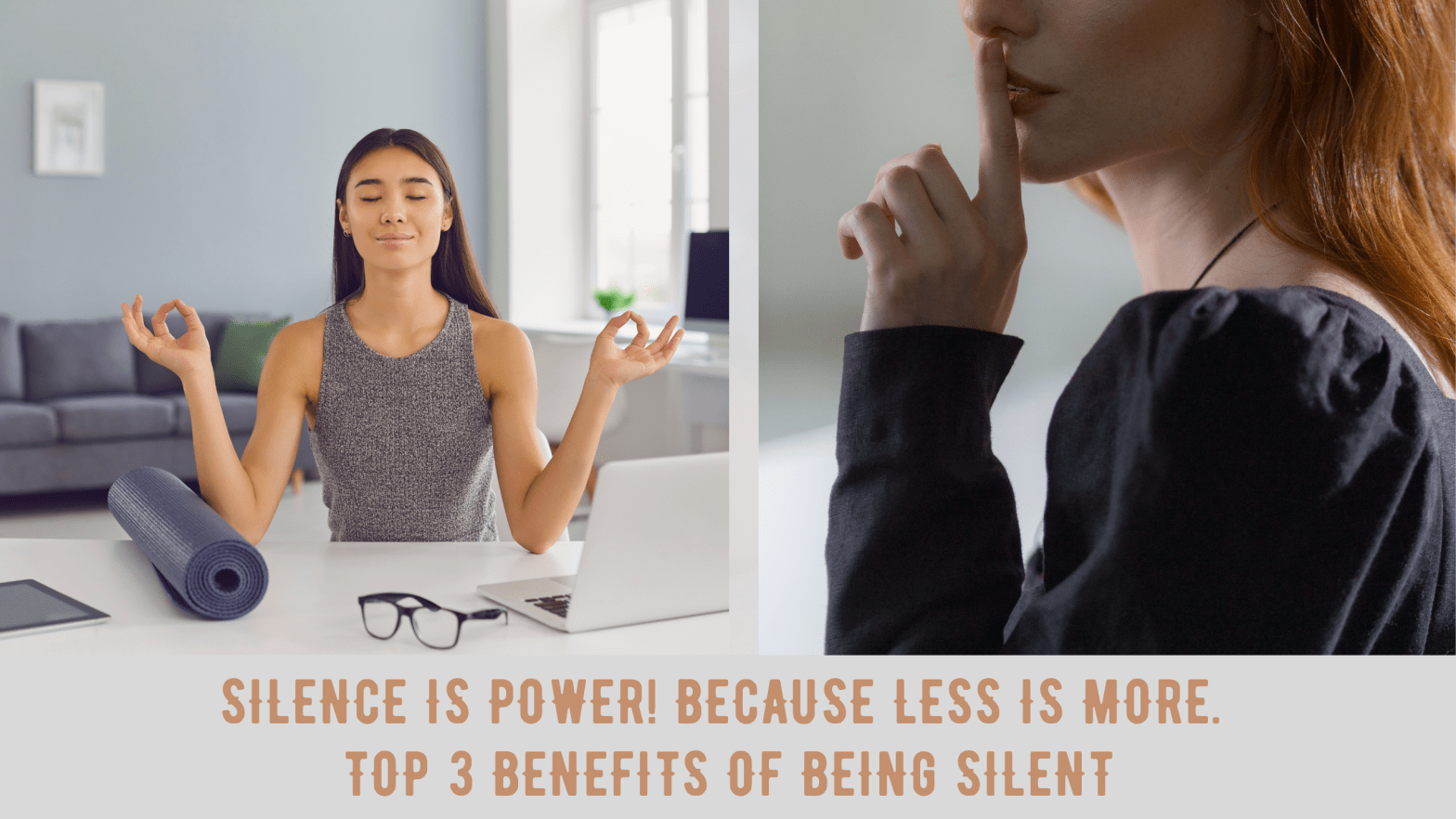
The power of silence is versatile. Silence can transcend speech, speak without words, and complement where verbal language is lacking.
And keeping silent also has advantages in terms of creativity, mental health, spiritual and religious practice, achieving the upper hand in negotiations, and even as a way to intimidate.
Silence is all-encompassing: mysterious but clear. soothing but painful, idle but useful, consenting but rebellious, and elusive but accessible. Silence is everything!
Four benefits of being silent.
(1) The quieter you are, the more you hear.
When we let go of all the words, we open ourselves up to other voices previously suppressed by continual verbal noise. These could be inner voices (as philosopher Ralph Waldo Emerson called the ‘inner knowing’) and outside voices and sounds that one misses because of a lack of listening.
We can listen effectively if we keep quiet, inside and outside. By keeping quiet, we become receptive to our surroundings. We pay attention to what our senses observe, so we learn and eventually become smarter and wiser.
If we refuse to keep quiet nor listen to what others have to say, we only share what we already know and don’t learn anything.
(2) Silence boosts creativity.
The theoretical physicist Albert Einstein argued that silence stimulates the creative mind.
When he couldn’t come up with an idea, he’d just stop thinking and “swim in silence,”(as he called it) and wait for the right information to come to him. Therefore, like many other great minds, Einstein spent a lot of time in solitude, using quietness to his advantage.
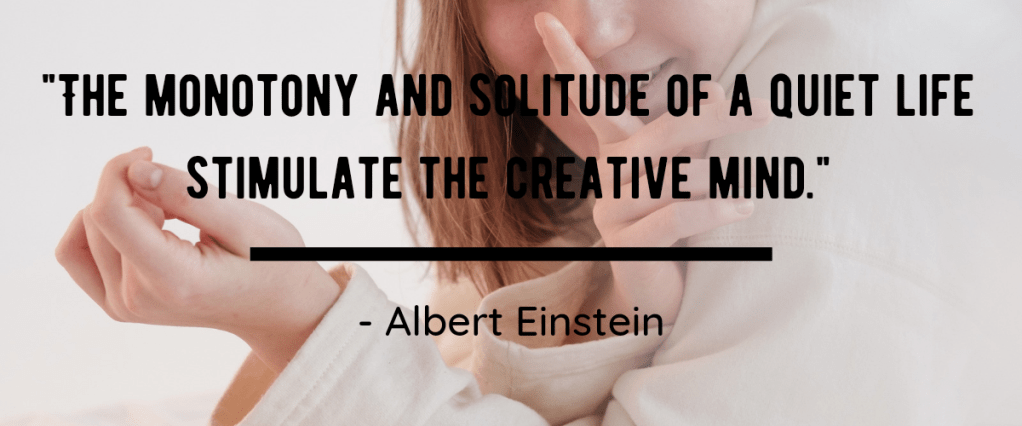
As he stated, and quote: “The monotony and solitude of a quiet life stimulate the creative mind.”
(3) Silence can send a powerful message.
In many cases, keeping quiet can send a much stronger message than using speech. By responding to words with silence or using rightly timed pauses during conversations, we’re able to communicate effectively without speaking or writing.
Silence allows us to express what discourse cannot. The many words uttered, ideas shared and promises made, never fully encompass the human experience.
However, the power of silence as an answer to tragedy is that we acknowledge that no amount of words do justice to what we seek to commemorate; it’s so significant to us that we’re willing to stop talking and be silent for a certain amount of time.
(4) Silence improves well-being.
How can one take refuge from a noisy world and a noisy intellect?
Innumerable experiences of many different people across the ages tell us that silence helps us calm our busy minds.
A significant body of research suggests that silence relaxes the mind, enhances sleep, and lessens insomnia. Also, a study found that two minutes of silence has a more calming effect than listening to relaxing music. Other studies show that environmental noise exposure increases stress hormone levels and can cause disruptions in sleep structure.
CONTENTS OF THE QUESTION
Each question would consist of 3 parts: Part 1: QUESTION – It would determine the path of knowing you as an individual.
Part 2: KNOW – It would let you know what you learned about yourself.
Part 3: QUOTE – It would depict the righteous approach to the concept being asked in the question.
HOW TO PRACTICE THIS ACTIVITY?
You just have to reply to Part 1, and just read, learn and reflect on Parts 2 and 3.
Grab a pen & paper and start writing your reply. Remember! Nothing is tough when it comes to doing it for yourself. And, you just need to be truthful to yourself.
Feel free to share.
Happy “soul-searching”
Download for free, these 3 wall art printable of high quality Pdf. 16×20in.
“All profound things and emotion of things are proceeded and attended by silence “
– Herman Melville
The power of silence is versatile.
Silence can transcend speech, speak without words, and complement where verbal language is lacking.
And keeping silent also has advantages in terms of creativity, mental health, spiritual and religious practice, achieving the upper hand in negotiations, and even as a way to intimidate.
This blog explores the power of silence, unfolding four benefits of being silent.
(1) The quieter you are, the more you hear.
The mystic and poet Jalal al-Din Muhammad Rūmi once realized that the quieter we become, the more we’re able to hear. From his mystical point of view, listening is essential, as Rumi tried to get closer to God and hear a “voice that doesn’t use words” by being still.
When we let go of all the words, we open ourselves up to other voices previously suppressed by continual verbal noise. These could be inner voices (as philosopher Ralph Waldo Emerson called the ‘inner knowing’) and outside voices and sounds that one misses because of a lack of listening.
We can listen effectively if we keep quiet, inside and outside. By keeping quiet, we become receptive to our surroundings. We pay attention to what our senses observe, so we learn and eventually become smarter and wiser.
If we refuse to keep quiet nor listen to what others have to say, we only share what we already know and don’t learn anything.
The ancient philosopher Pythagoras once stated: “A fool is known by his speech, and a wise man by silence,”
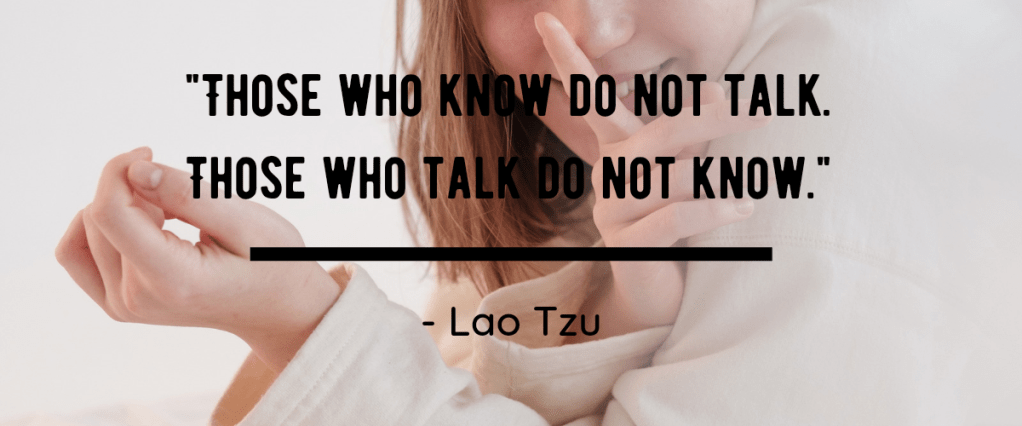
Similarly, Lao Tzu wrote: “Those who know do not talk. Those who talk do not know.”
Being quiet helps us learn about the environment and recognize dangers (and opportunities) that we would have skipped if we were too busy talking. But it also allows us to gather information about ourselves.
Often, people are so busy overthinking. worrying, ruminating, and analyzing we block ideas and solutions that are already within us from coming to the surface because our conscious minds generate too much noise.
Keeping quiet can also lead to more philosophical, and spiritual insights. We are not our thoughts, according to the Buddha And if we quiet down and observe our thoughts, we’ll discover that everything we think, all our ideas, concepts, and identifications, are fleeting.
Hence, according to the Buddha, a fixed self isn’t really there. But we only discover the illusory nature of thoughts if we keep quiet and observe and recognize them for what they are.
(2) Silence boosts creativity.
The theoretical physicist Albert Einstein argued that silence stimulates the creative mind.
When he couldn’t come up with an idea, he’d just stop thinking and “swim in silence,”(as he called it) and wait for the right information to come to him. Therefore, like many other great minds, Einstein spent a lot of time in solitude, using quietness to his advantage.
Albert Einstein stated, and quote: “The monotony and solitude of a quiet life stimulate the creative mind.”
Thus, we have insights when our overall activity level in the brain is low.
This happens when we’re either doing something that doesn’t require a lot of mental effort when we’re focusing on something repetitive or just generally more relaxed like when we wake up.
Insights require a quiet mind because they are quiet. So, it seems that we need to create the right circumstances for our minds to quiet down.
For some people, this may be going for a walk and repetitive forms of exercise or listening to calming music. For others, like Einstein, it might be dwelling in silence and solitude.
Many of the great minds, like Isaac Newton, Elizabeth Bishop, and Nikola Tesla, worked alone in quiet places.
(3) Silence can send a powerful message.
In many cases, keeping quiet can send a much stronger message than using speech. By responding to words with silence or using rightly timed pauses during conversations, we’re able to communicate effectively without speaking or writing.
Silence allows us to express what discourse cannot. The many words uttered, ideas shared and promises made, never fully encompass the human experience.
However, the power of silence as an answer to tragedy is that we acknowledge that no amount of words do justice to what we seek to commemorate; it’s so significant to us that we’re willing to stop talking and be silent for a certain amount of time.
Is there a better way of showing respect? In conversation, using silence can be powerful as well.
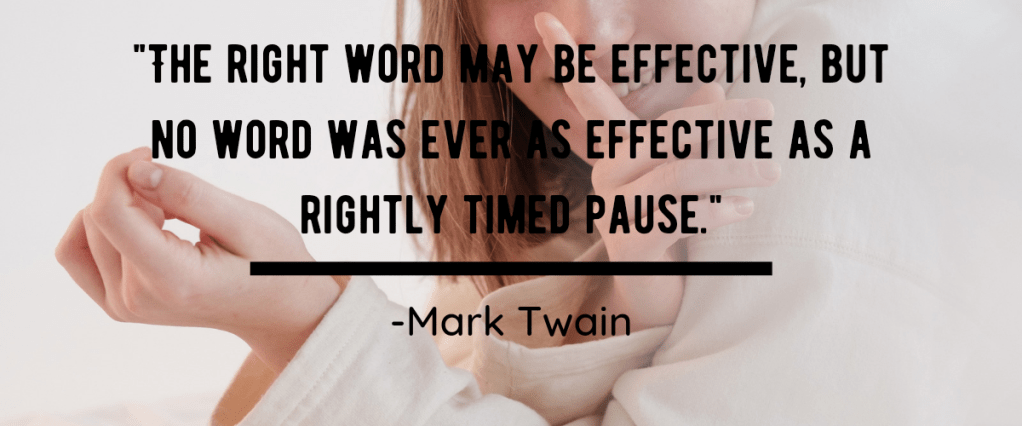
American author Mark Twain stated, and I quote: “The right word may be effective, but no word was ever as effective as a rightly timed pause.”
Academic research shows that silence in a conversation starts to feel unbearable for approximately four seconds.
Making people start wondering: – Did I say something wrong? – Does this person dislike me? – What’s going to happen next?
And so, the person on the receiving end of the silence may proceed to make any decision just to end the uneasiness of the uncertain gap in the communication. And this decision could be beneficial to the person brave enough to keep silent at the right moment.
Another benefit of keeping silent during conversations is that it’s safer than speech. In some situations, whatever we say weakens our position. For example, if we’re part of a conversation about a subject we don’t know anything about.
In such cases, it’s more powerful to listen: not just because listening grants us the opportunity to learn but also because we don’t make a fool out of ourselves by trying to appear knowledgeable when we are not. Moreover, keeping silent shows that we’re interested and willing to listen, which people generally appreciate.
Roman writer Publilius Syrus once stated: “I often regret that I have spoken; never that have been silent.”
(4) Silence improves well-being.
How can one take refuge from a noisy world and a noisy intellect?
Innumerable experiences of many different people across the ages tell us that silence helps us calm our busy minds.
A significant body of research suggests that silence relaxes the mind, enhances sleep, and lessens insomnia. Also, a study found that two minutes of silence has a more calming effect than listening to relaxing music. Other studies show that environmental noise exposure increases stress hormone levels and can cause disruptions in sleep structure.
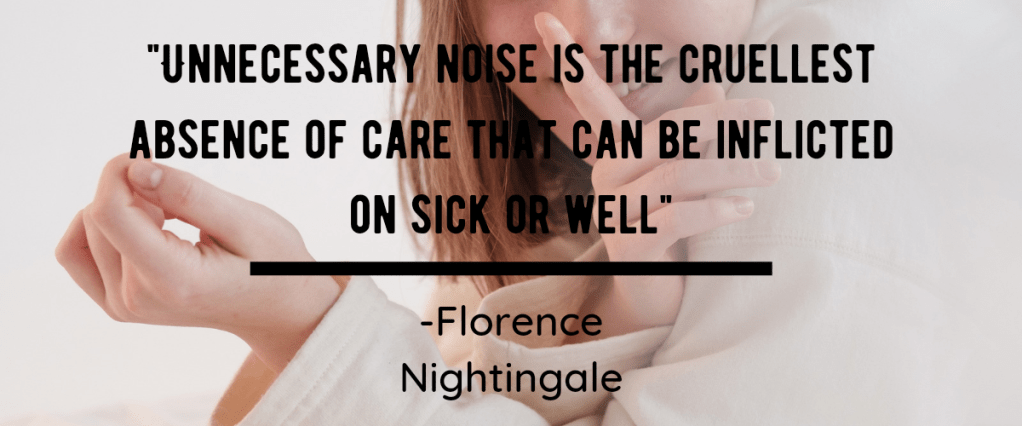
Wrote Florence Nightingale, an English social reformer and founder of modern nursing.
In an article on Psychology Today, author George Michelsen Foy tells us that we’ve learned to tolerate noise and see it as something positive in our modern society.
Noise means that the machines are working; all technologies we’ve created are up and running. But by tolerating this noise, we “make a serious mistake,” according to Foy.
Noise kills, and that excessive input does real damage and is detrimental to our ability to function: an argument backed up by a copious amount of studies. Hence, to escape the unhealthy flow of information and noise, we need to build silence into our lives.
Moments of silence improve overall well-being and performance. The release is what I’m truly craving here, and release comes from emptiness. The emptiness of silence, of lonely landscapes, of closed eyes, of lying down in a dark, quiet room.
To think better. To question, for a second, our baseline. It is important to do that. Silence is minimalistic and empty, yet imposing and powerful. We can’t verbalize silence, but everyone understands it.
Those were the 4 ways…
It’s all-encompassing: mysterious but clear. soothing but painful, idle but useful, consenting but rebellious, and elusive but accessible. Silence is everything!
Download for free, these 3 wall art printable of high quality Pdf. 16×20in.
There is a lot of information you can learn that loses much of its usefulness in a couple of years. I believe we focus too much on that kind of immediate knowledge and always forget to explore skills that take a longer time to learn and require more consistent practice.
But when you do master those skills they pay off forever because they can be applied all the time and they have a true impact on how you’re living your life.
And, I wanted to discuss these because these tasks need time and learning but a week is sufficient to convince oneself to get along these because these are worth investing our time and effort.
Here are the three skills that although they are hard to learn, do pay off forever.
3 tips to conquer a week
I. Self-analysis
Self-analysis is the ability to explore and investigate your own personal thoughts emotions and behavior. Although it may occur non-consciously. Developing the habit of pursuing this regularly can help you in a lot of different contexts.
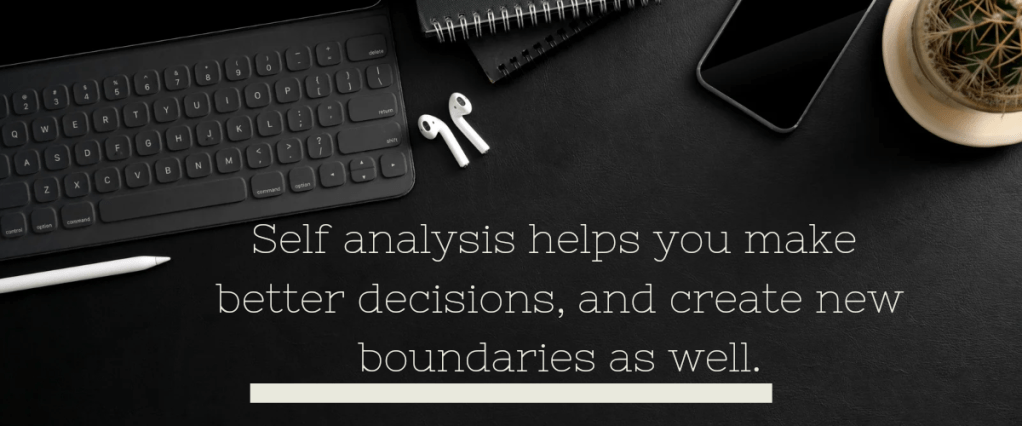
As you consider your own thoughts and self-examine your motivation you can better get a grasp on yourself and understands; where you actually want to be and how do you act the way you act. This basically helps you make better decisions, and create new boundaries as well.
Think about life goals maybe you never dared to think about before overall this also helps you learn more about yourself instead of jumping into the crowd and doing whatever everyone else is doing.
II. Public speaking
This one is hard if you’re a shy person. Public speaking is hell for me it’s one of the hardest things to do especially if it’s in some sort of academic environment.
However, I can tell you from personal experience that practicing this and trying to develop public speaking as much as possible really goes a long way in so many different settings from your work performance to the kind of opportunities you end up embracing.
The way you present yourself and how you speak your own ideas out loud does so much for you. And it’s also that kind of skill that you can learn on your own by practising putting yourself out there and reading the correct staple textbooks.
III. Time management
Managing your time is managing your life. It takes some time to understand how you can manage your calendar better. And it also requires some readjusting.
After all our life is constantly changing and with it so do our priorities our projects and our routines.
However, learning how you can schedule prioritize, and organize tasks and take into account your values your priorities as well as your energy levels will have such a big impair your lifestyle and the quality of your life you’ll have way more time in the day and you’ll feel so more Time in the day and you’ll feel so much more accomplished and fulfilled overall.
Those were the top 3 tips that you need to conquer a week with fruitful hard work.
Power is endlessly seductive and deceptive in its own way. Do not be frivolous with such a critical matter. The gods of power frown on the frivolous; they give ultimate satisfaction only to those who study and reflect, and punish those who skim the surfaces looking for a good time.
The 48 Laws of Power
LAW 1
NEVER OUTSHINE THE MASTER Always make those above you feel comfortably superior. In your desire to please or impress them, do not go too far in displaying your talents or you might accomplish the opposite inspire fear and insecurity. Make your masters appear more brilliant than they are and you will attain the heights of power.
LAW 2
NEVER PUT TOO MUCH TRUST IN FRIENDS, LEARN HOW TO USE ENEMIES Be wary of friends they will betray you more quickly, for they are easily aroused to envy. They also become spoiled and tyrannical. But hire a former enemy and he will be more loyal than a friend, because he has more to prove. In fact, you have more to fear from friends than from enemies. If you have no enemies, find a way to make them.
LAW 3
CONCEAL YOUR INTENTIONS Keep people off-balance and in the dark by never revealing the purpose behind your actions. If they have no clue what you are up to, they cannot prepare a defense. Guide them far enough down the wrong path, envelop them in enough smoke, and by the time they realize your intentions, it will be too late.
LAW 4
ALWAYS SAY LESS THAN NECESSARY When you are trying to impress people with words, the more you say, the more common you appear, and the less in control. Even if you are saying something banal, it will seem original if you make it vague, open- ended, and sphinxlike. Powerful people impress and intimidate by saying less. The more you say, the more likely you are to say something foolish.
LAW 5
SO MUCH DEPENDS ON REPUTATIONGUARD IT WITH YOUR LIFE Reputation is the cornerstone of power. Through reputation alone you can intimidate and win; once it slips, however, you are vulnerable, and will be attacked on all sides. Make your reputation unassailable. Always be alert to potential attacks and thwart them before they happen. Meanwhile, learn to destroy your enemies by opening holes in their own reputations. Then stand aside and let public opinion hang them.
LAW 6
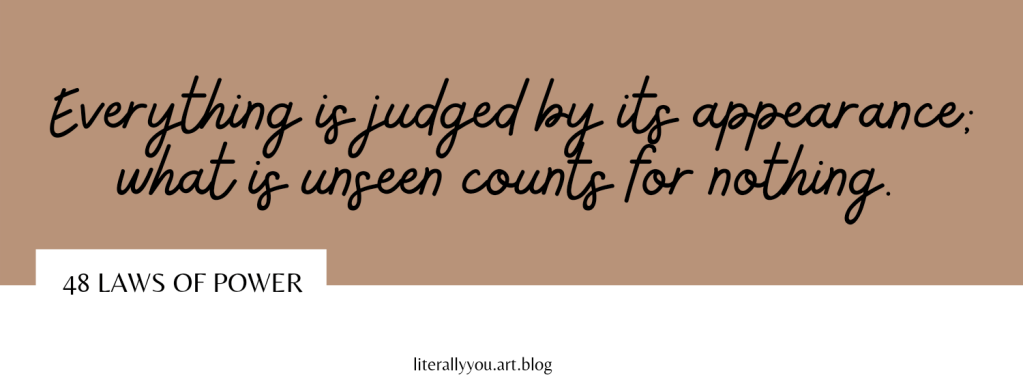
COURT ATTENTION AT ALL COST Everything is judged by its appearance; what is unseen counts for nothing. Never let yourself get lost in the crowd, then, or buried in oblivion. Stand out. Be conspicuous, at all cost. Make yourself a magnet of attention by appearing larger, more colorful, more mysterious than the bland and timid masses.
LAW 7
GET OTHERS TO DO THE WORK FOR YOU, BUT ALWAYS TAKE THE CREDIT Use the wisdom, knowledge, and legwork of other people to further your own cause. Not only will such assistance save you valuable time and energy, it will give you a godlike aura of efficiency and speed. In the end your helpers will be forgotten and you will be remembered. Never do yourself what others can do for you.
LAW 8
MAKE OTHER PEOPLE COME TO YOUUSE BAIT IF NECESSARY When you force the other person to act, you are the one in control. It is always better to make your opponent come to you, abandoning his own plans in the process. Lure him with fabulous gains then attack. You hold the cards.
LAW 9
WIN THROUGH YOUR ACTIONS, NEVER THROUGH ARGUMENT Any momentary triumph you think you have gained through argument is really a Pyrrhic victory: The resentment and ill will you stir up is stronger and lasts longer than any momentary change of opinion. It is much more powerful to get others to agree with you through your actions, without saying a word. Demonstrate, do not explicate.
LAW 10
INFECTION: AVOID THE UNHAPPY AND UNLUCKY You can die from someone else’s misery emotional states are as infectious as diseases. You may feel you are helping the drowning man but you are only precipitating your own disaster. The unfortunate sometimes draw misfortune on themselves; they will also draw it on you. Associate with the happy and fortunate instead.
LAW 11
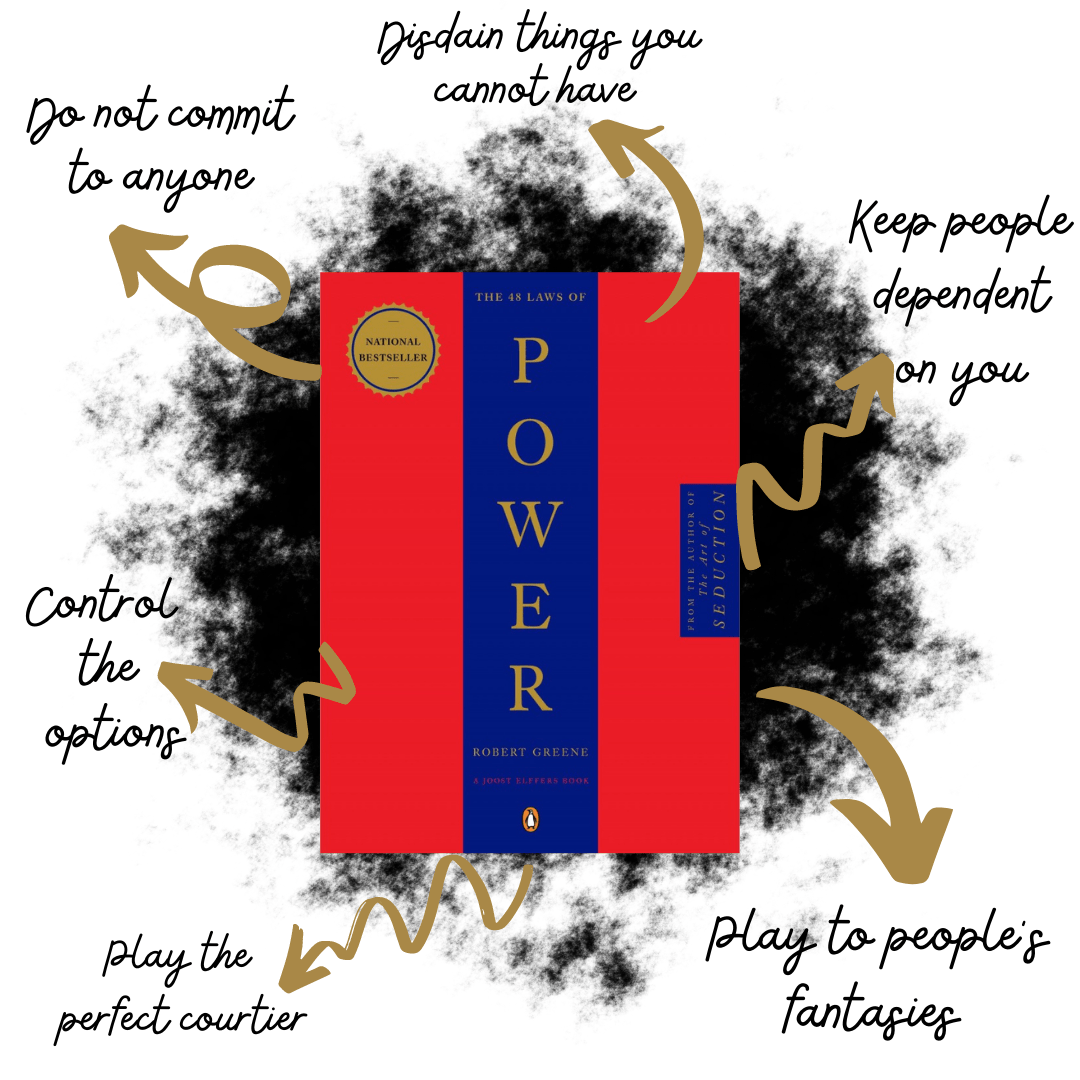
LEARN TO KEEP PEOPLE DEPENDENT ON YOU To maintain your independence you must always be needed and wanted. The more you are relied on, the more freedom you have. Make people depend on you for their happiness and prosperity and you have nothing to fear. Never teach them enough so that they can do without you.
LAW 12
USE SELECTIVE HONESTY AND GENEROSITY TO DISARM YOUR VICTIM One sincere and honest move will cover over dozens of dishonest ones. Open-hearted gestures of honesty and generosity bringdown the guard of even the most suspicious people. Once your selective honesty opens a hole in their armor, you can deceive and manipulate them at will. A timely gifta Trojan horse will serve the same purpose.
LAW 13
WHEN ASKING FOR HELP, APPEAL TO PEOPLE’S SELF- INTEREST, NEVER TO THEIR MERCY OR GRATITUDE If you need to turn to an ally for help, do not bother to remind him of your past assistance and good deeds. He will find a way to ignore you. Instead, uncover something in your request, or in your alliance with him, that will benefit him, and emphasize it out of all proportion. He will respond enthusiastically when he sees something to be gained for himself.
LAW 14
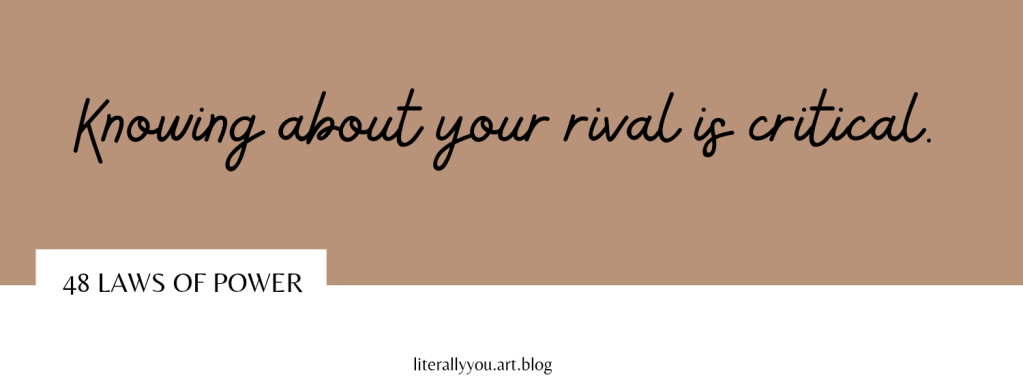
POSE AS A FRIEND, WORK AS A SPY Knowing about your rival is critical. Use spies to gather valuable information that will keep you a step ahead. Better still: Play the spy yourself. In polite social encounters, learn to probe. Ask indirect questions to get people to reveal their weaknesses and intentions. There is no occasion that is not an opportunity for artful spying.
LAW 15
CRUSH YOUR ENEMY TOTALLY All great leaders since Moses have known that a feared enemy must be crushed completely. (Sometimes they have learned this the hard way.) If one ember is left alight, no matter how dimly it smolders, afire will eventually break out. More is lost through stopping halfway than through total annihilation: The enemy will recover, and will seek revenge. Crush him, not only in body but in spirit.
LAW 16
USE ABSENCE TO INCREASE RESPECT AND HONOR Too much circulation makes the price go down: The more you are seen and heard from, the more common you appear. If you are already established in a group, temporary withdrawal from it will make you more talked about, even more admired. You must learn when to leave. Create value through scarcity.
LAW 17
KEEP OTHERS IN SUSPENDED TERROR: CULTIVATE AN AIR OF UNPREDICTABILITY Humans are creatures of habit with an insatiable need to see familiarity in other people’s actions. Your predictability gives them a sense of control. Turn the tables: Be deliberately unpredictable. Behavior that seems to have no consistency or purpose will keep them off-balance, and they will wear themselves out trying to explain your moves. Taken to an extreme, this strategy can intimidate and terrorize.
LAW 18
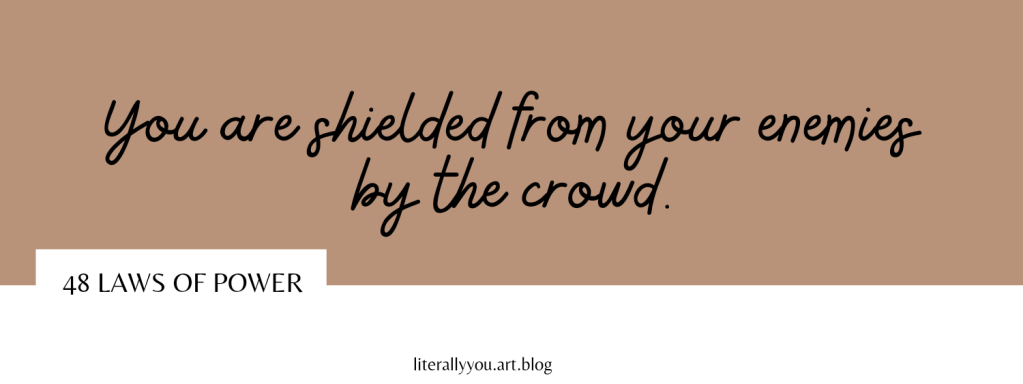
DO NOT BUILD FORTRESSES TO PROTECT YOURSELF ISOLATION IS DANGEROUS The world is dangerous and enemies are everywhere everyone has to protect themselves. A fortress seems the safest. But isolation exposes you to more dangers than it protects you from it cuts you off from valuable information, it makes you conspicuous and an easy target. Better to circulate among people, find allies, mingle. You are shielded from your enemies by the crowd.
LAW 19
KNOW WHO YOU’RE DEALING WITH DO NOT OFFEND THE WRONG PERSON There are many different kinds of people in the world, and you can never assume that everyone will react to your strategies in the same way. Deceive or outmaneuver some people and they will spend the rest of their lives seeking revenge. They are wolves in lambs’ clothing. Choose your victims and opponents carefully, then never offend or deceive the wrong person.
LAW 20
DO NOT COMMIT TO ANYONE It is the fool who always rushes to take sides. Do not commit to any side or cause but yourself. By maintaining your independence, you become the master of others playing people against one another, making them pursue you.
LAW 21
PLAY A SUCKER TO CATCH A SUCKERSEEM DUMBER THAN YOUR MARK No one likes feeling stupider than the next person. The trick, then, is to make your victims feel smart and not just smart, but smarter than you are. Once convinced of this, they will never suspect that you may have ulterior motives.
LAW 22
USE THE SURRENDER TACTIC: TRANSFORM WEAKNESS INTO POWER When you are weaker, never fight for honor’s sake; choose surrender instead. Surrender gives you time to recover, time to torment and irritate your conqueror, time to wait for his power to wane. Do not give him the satisfaction of fighting and defeating you surrender first. By turning the other cheek you infuriate and unsettle him. Make surrender a tool of power.
LAW 23
CONCENTRATE YOUR FORCES Conserve your forces and energies by keeping them concentrated at their strongest point. You gain more by finding a rich mine and mining it deeper, than by flitting from one shallow mine to another intensity defeats ex-tensity every time. When looking for sources of power to elevate you, find the one key patron, the fat cow who will give you milk for a long time to come.
LAW 24
PLAY THE PERFECT COURTIER The perfect courtier thrives in a world where everything revolves around power and political dexterity. He has mastered the art of indirection; he flatters, yields to superiors, and asserts power over others most obliquely and gracefully. Learn and apply the laws of courtiers and there will be no limit to how far you can rise in the court.
LAW 25
RE-CREATE YOURSELF Do not accept the roles that society foists on you. Re-create yourself by forging a new identity, one that commands attention and never bores the audience. Be the master of your own image rather than letting others define it for you. Incorporate dramatic devices into your public gestures and actions your power will be enhanced and your character will seem larger than life.
LAW 26
KEEP YOUR HANDS CLEAN You must seem a paragon of civility and efficiency: Your hands are never soiled by mistakes and nasty deeds. Maintain such a spotless appearance by using others as scapegoats and cat’s-paws to disguise your involvement.
LAW 27
PLAY ON PEOPLE’S NEED TO BELIEVE TO CREATE A CULTLIKE FOLLOWING People have an overwhelming desire to believe in something. Become the focal point of such desire by offering them a cause, a new faith to follow. Keep your words vague but full of promise; emphasize enthusiasm over rationality and clear thinking. Give your new disciples rituals to perform, ask them to make sacrifices on your behalf. In the absence of organized religion and grand causes, your new belief system will bring you untold power.
LAW 28
ENTER ACTION WITH BOLDNESS If you are unsure of a course of action, do not it. Your doubts and hesitations will infect your execution. Timidity is dangerous: Better to enter with boldness. Any mistakes you commit through audacity are easily corrected with more audacity. Everyone admires the bold; no one honors the timid.
LAW 29
PLAN ALL THE WAY TO THE END The ending is everything. Plan all the way to it, taking into account all the possible consequences, obstacles, and twists of fortune that might reverse your hard work and give the glory to others. By planning to the end you will not be overwhelmed by circumstances and you will know when to stop. Gently guide fortune and help determine the future by thinking far ahead.
LAW 30
MAKE YOUR ACCOMPLISHMENTS SEEM EFFORTLESS Your actions must seem natural and executed with ease. All the toil and practice that go into them, and also all the clever tricks, must be concealed. When you act, act effortlessly, as if you could do much more. Avoid the temptation of revealing how hard you work it only raises questions. Teach no one your tricks or they will be used against you.
LAW 31
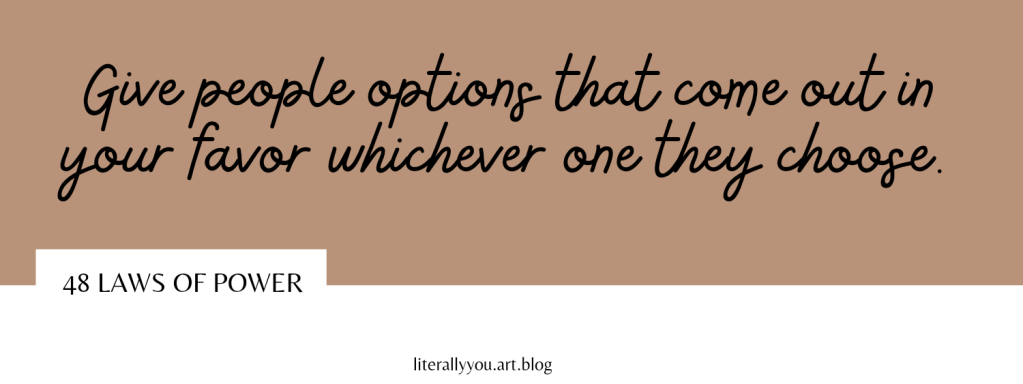
CONTROL THE OPTIONS: GET OTHERS TO PLAY WITH THE CARDS YOU DEAL The best deceptions are the ones that seem to give the other person a choice: Your victims feel they are in control, but are actually your puppets. Give people options that come out in your favor whichever one they choose. Forte them to make choices between the lesser of two evils, both of which serve your purpose. Put them on the horns of a dilemma: They are gored wherever they turn.
LAW 32
PLAY TO PEOPLE’S FANTASIES The truth is often avoided because it is ugly and unpleasant. Never appeal to truth and reality unless you are prepared for the anger that comes from disenchantment. Life is so harsh and distressing that people who can manufacture romance or conjure up fantasy are like oases in the desert: Everyone flocks to them. There is great power in tapping into the fantasies of the masses.
LAW 33
DISCOVER EACH MAN’S THUMBSCREW Everyone has a weakness, a gap in the castle wall. That weakness is usually an insecurity, an uncontrollable emotion or need; it can also be a small secret pleasure. Either way, once found, it is a thumbscrew you can turn to your advantage.
LAW 34
BE ROYAL IN YOUR OWN FASHION: ACT LIKE A KING TO BE TREATED LIKE ONE The way you carry yourself will often determine how you are treated: In The the long run, appearing vulgar or common will make people disrespect you. For a king respects himself and inspires the same sentiment in others. By acting regally and confident of your powers, you make yourself seem destined to wear a crown.
LAW 35
MASTER THE ART OF TIMING Never seem to be in a hurryhurrying betrays a lack of control over yourself and over time. Always seem patient, as if you know that everything will come to you eventually. Become a detective of the right moment; sniff out the spirit of the times, the trends that will carry you to power. Learn to stand back when the time is not yet ripe, and to strike fiercely when it has reached fruition.
LAW 36
DISDAIN THINGS YOU CANNOT HAVE: IGNORING THEM IS THE BEST REVENGE By acknowledging a petty problem you give it existence and credibility. The more attention you pay an enemy, the stronger you make him; and a small mistake is often made worse and more visible when you try to fix it. It is sometimes best to leave things alone. If there is something you want but cannot have, show contempt for it. The less interest you reveal, the more superior you seem.
LAW 37
CREATE COMPELLING SPECTACLES Striking imagery and grand symbolic gestures create the aura of power everyone responds to them. Stage spectacles for those around you, then, full of arresting visuals and radiant symbols that heighten your presence. Dazzled by appearances, no one will notice what you are really doing.
LAW 38
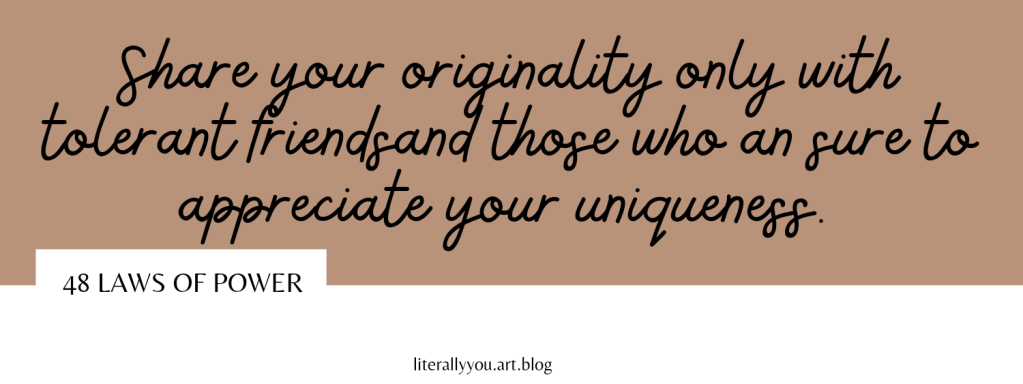
THINK AS YOU LIKE BUT BEHAVE LIKE OTHERS If you make a show of going against the times, flaunting your unconventional ideas and unorthodox ways, people will think that you only want attention and that you look down upon them. They will find a way to punish you for making them feel inferior. It is far safer to blend in and nurture the common touch. Share your originality only with tolerant friends and those who an sure to appreciate your uniqueness.
LAW 39
STIR UP WATERS TO CATCH FISH Anger and emotion are strategically counterproductive. You must always stay calm and objective. But if you can make your enemies angry while staying calm yourself, you gain a decided advantage. Put your enemies off-balance: Find the chink in their vanity through which you can rattle them and you hold the strings.
LAW 40
DESPISE THE FREE LUNCH What is offered for free is dangerous it usually involves either a trick or a hidden obligation. What has worth is worth paying for. By paying your own way you stay clear of gratitude, guilt, and deceit. It is also often wise to pay the full price there is no cutting corners with excellence. Be lavish with your money and keep it circulating, for generosity is a sign and a magnet for power.
LAW 41
AVOID STEPPING INTO A GREAT MAN’S SHOES What happens first always appears better and more original than what comes after. If you succeed a great man or have a famous parent, you will have to accomplish double their achievements to outshine them. Do not get lost in their shadow, or stuck in a past not of your own making: Establish your own name and identity by changing course. Slay the overbearing father, disparage his legacy, and gain power by shining in your own way.
LAW 42
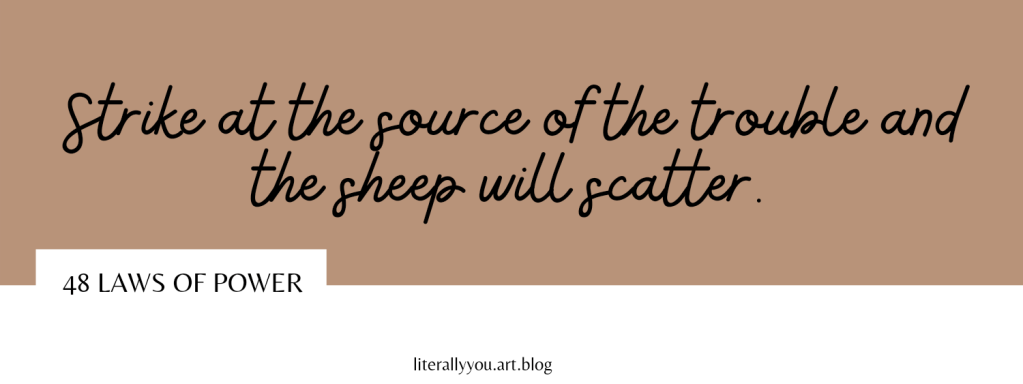
STRIKE THE SHEPHERD AND THE SHEEP WILL SCATTER Trouble can often be traced to a single strong individual the stirrer, the arrogant underling, the poisoner of goodwill. If you allow such people room to operate, others will succumb to their influence. Do not wait for the troubles they cause to multiply, do not try to negotiate with them they are irredeemable. Neutralize their influence by isolating or banishing them. Strike at the source of the trouble and the sheep will scatter.
LAW 43
WORK ON THE HEARTS AND MINDS OF OTHERS Coercion creates a reaction that will eventually work against you. You must seduce others into wanting to move in your direction. A person you have seduced becomes your loyal pawn. And the way to seduce others is to operate on their individual psychologies and weaknesses. Soften up the resistance by working on their emotions, playing on what they hold dear and what they fear. Ignore the hearts and minds of others and they will grow to hate you.
LAW 44
DISARM AND INFURIATE WITH THE MIRROR EFFECT The mirror reflects reality, but it is also the perfect tool for deception: When you mirror your enemies, doing exactly as they do, they cannot figure out your strategy. The Mirror Effect mocks and humiliates them, making them overreact. By holding up a mirror to their psyches, you seduce them with the illusion that you share their values; by holding up a mirror to their actions, you teach them a lesson. Few can resist the power of the Mirror Effect.
LAW 45
PREACH THE NEED FOR CHANGE, BUT NEVER REFORM TOO MUCH AT ONCE Everyone understands the need for change in the abstract, but on the day-to-day level, people are creatures of habit. Too much innovation is traumatic and will lead to revolt. If you are new to a position of power, or an outsider trying to build a power base, make a show of respecting the old way of doing things. If change is necessary, make it feel like a gentle improvement from the past.
LAW 46
NEVER APPEAR TOO PERFECT Appearing better than others is always dangerous, but most dangerous of all is to appear to have no faults or weaknesses. Envy creates silent enemies. It is smart to occasionally display defects, and admit to harmless vices, to deflect envy and appear more human and approachable. Only gods and the dead can seem perfect with impunity
LAW 47
DO NOT GO PAST THE MARK YOU AIMED FOR; IN VICTORY, LEARN WHEN TO STOP The moment of victory is often the moment of greatest peril. In the heat of victory, arrogance and overconfidence can push you past the goal you had aimed for, and by going too far, you make more enemies than you defeat. Do not allow success to go to your head. There is no substitute for strategy and careful planning. Set a goal, and when you reach it, stop.
LAW 48
ASSUME FORMLESSNESS By taking a shape, by having a visible plan, you open yourself to attack. Instead of taking a form for your enemy to grasp, keep yourself adaptable and on the move. Accept the fact that nothing is certain and no law is fixed. The best way to protect yourself is to be as fluid and formless as water; never bet on stability or lasting order. Everything changes.
To lead your life with a healthy attitude you need to get control over your life. Here, are 3 habits you must incorporate into your daily schedule to change your life for the good.
HABITS keeps you hooked with the routine and serves by releasing you free from taking too many decisions.
And, the ultimate benefit of not taking too many decisions is to keep your energies and efforts reserved for those decisions of the day, which require more brainpower among other decisions.
Building more good habits limits your bad habits which evidently work towards building a worth living life for yourself.
And, that’s why I’m so obsessed with these habits as they have helped me to stand tall with the right attitude every day, making me feel righteous even when people tag me self-centered or self-obsessed. It is all about loving your progress as a person.
These habits have helped me to transform my aimless, boring existence and literally turned me into the high-performing, and ambitious designer of my life so far.
Let’s get started with the top 3 HABITS you would require to lead your journey of life successfully through self-care.
3 tips to conquer the week
3 ways of self-care
I. BEING PRESENT
More often you feel empty when you invest your thought process on someone else than yourself. When you prioritize them in your mental space than yourself.
Whether it’s through daydreaming, imagining, or thinking, many times you unconsciously feed your distractions from the very present moment.
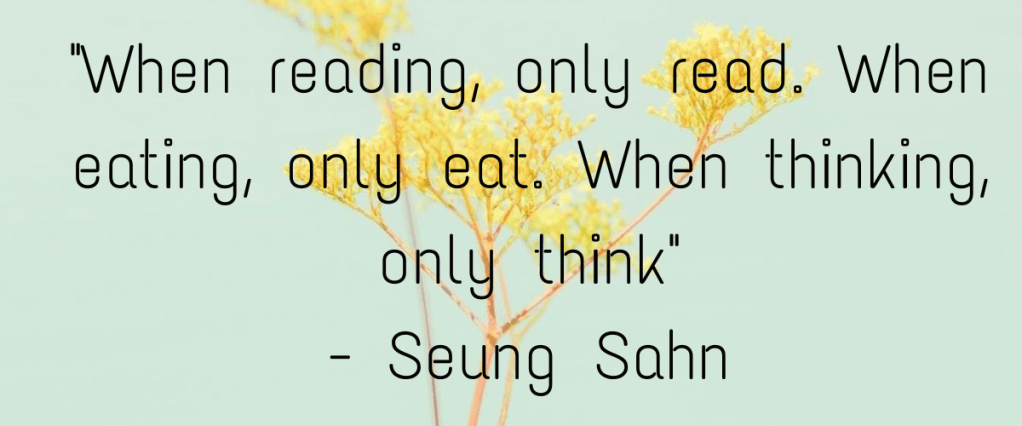
“When reading, only read. When eating, only eat. When thinking, only think” – Seung Sahn
Now, what does it mean to be present? It may sound quite obvious. Although we overlook the most obvious things with any much meaningful cause. To be present simply means paying attention.
If you are doing something which is certainly favoring your interest, you should be absolutely focusing in working out that thing for yourself. Instead, of thinking about any of the better situations where you could have been if not in this.
II. TAKE CREDIT FOR YOUR WORK
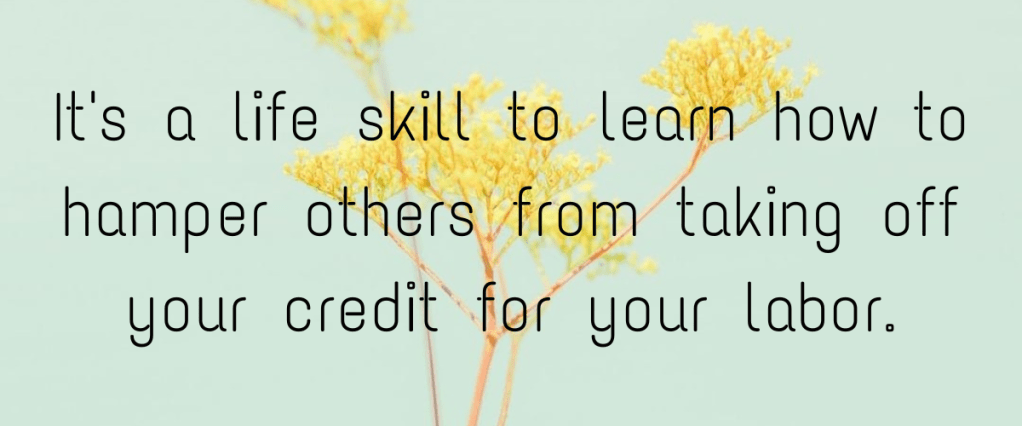
Always remember you are in charge of your life, don’t forget to stand up for yourself. It’s a life skill to learn how to hamper others from taking off your credit for your labor.
Begin with, taking out time to calm down and not to act on an impulse. It tends to break your alignment with what you need to rely upon. And, communication is not your forte at that moment.
Then, try to set things straight to the credit taker. Either let the credit taker know not to practice unethical means or approach them with the repercussions of their action, whatsoever you feel preferably reverting them with.
Never overlook the credit takers. It’s not worth it on our part simply because you deserve and must stand for like yourself.
III. ADDRESS YOUR EMOTIONS
There is usually a reason why you get into a funk or whatever episode you are dealing with, which makes you feel drained with motivation. And, a crucial part of it is to address those emotions.
It actually takes way more energy to run away and escape from those emotions than to face them head-on. It actually takes a few minutes to get those emotions out.
But, when we don’t deal with them and we push them away and try to run away that’s when we let ourselves feel them much more by holding upon them. And, end up feeling stuck and unmotivated.
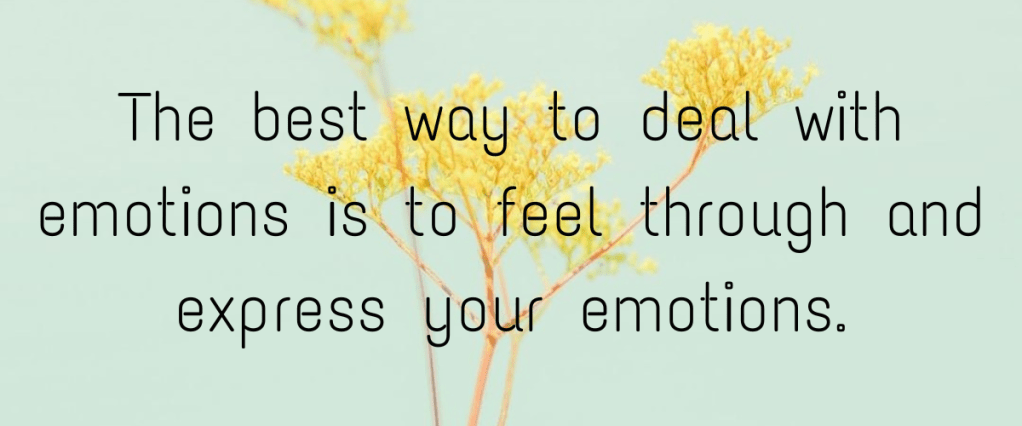
The best way to deal with emotions is to feel through and express your emotions.
One myth people hold on to express their emotions is to find someone to express their emotions to. Why do you feel that you need someone to make you like feel being heard?
You don’t need someone to make you feel secure about your feelings. Moreover, you can only get rid of the insecurity of not being emotionally supported or backed by someone by building security within yourself.
– Think, of having self-talk rather than looking listening listen to your low emotions. – Acknowledge, that no one knows you better than you know yourself and therefore only you can work in the best interest of dealing with your emotions







 Literally You