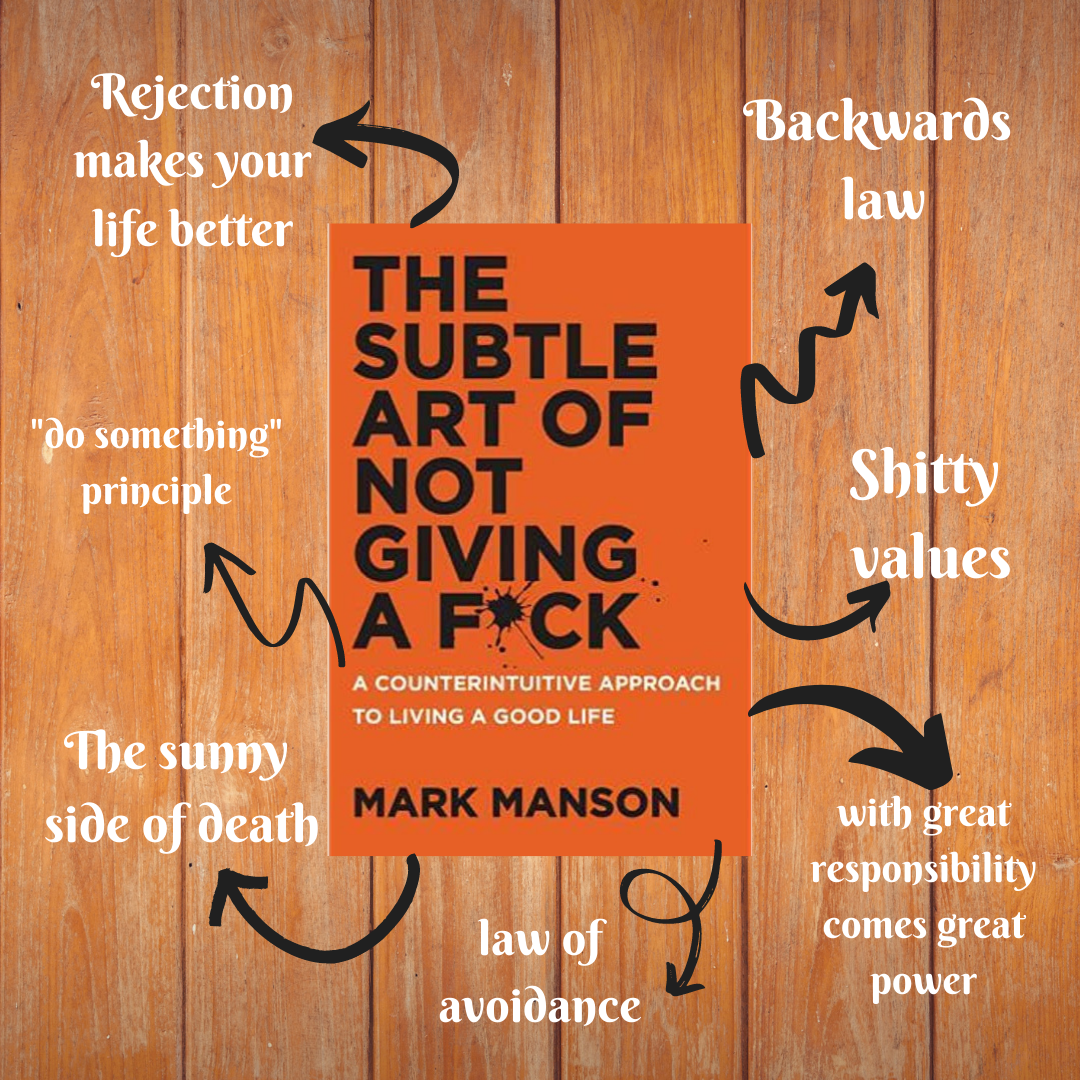
A counterintuitive approach to living a good life.
Chapter 1: DON’T TRY
How to be happy?
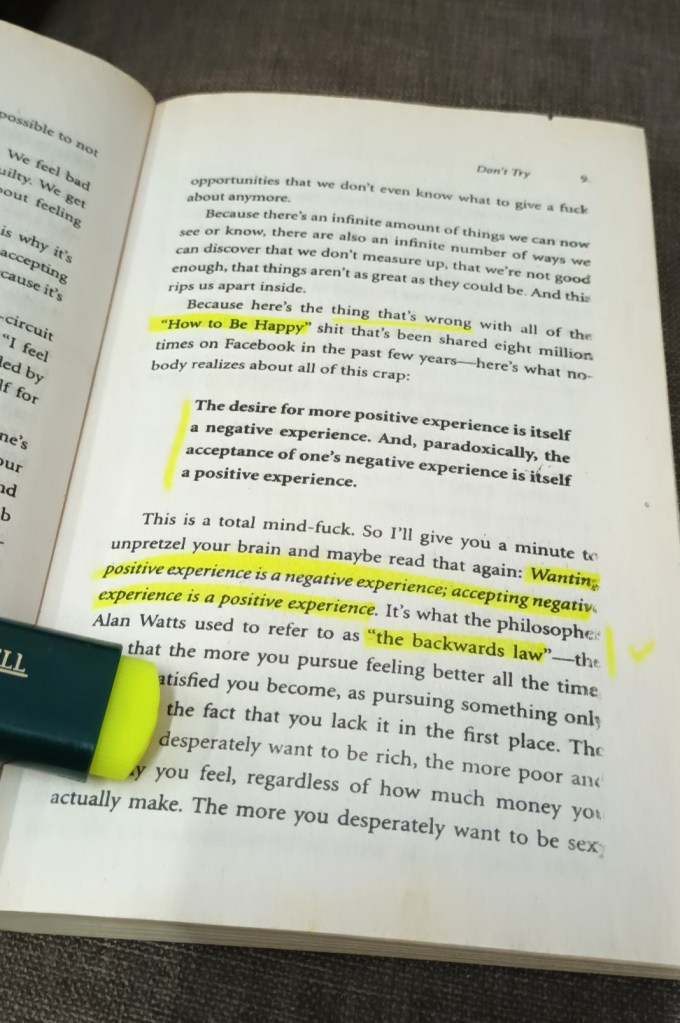
The desire for a more positive experience or itself a negative experience. And, paradoxically, the acceptance of one’s negative experience is itself a positive experience.
“The backwards law” by Alan Watts:
‘Wanting a positive experience is a negatives experience; accepting a negative experience is positive.’
What does not giving a fuck mean?
#1: Not giving a fuck doesn’t mean being indifferent; it means being comfortable with being different.
#2: To not give a fuck about adversity, you must first give a fuck about something more important than adversity.
#3: Whether you realize it or not, you are always choosing what to give a fuck about.
Chapter 2: HAPPINESS IS A PROBLEM
Life itself is a form of suffering.
– The rich suffer because of their riches.
– The poor suffer because of their riches.
– The poor suffer because of their poverty.
– People without a family suffer because they have no family.
– People with a family suffer because of their family.
– People who pursue worldly pleasures suffer because of their worldly pleasures.
– People who abstain from worldly pleasure suffer because of their abstention.
This isn’t to say that all suffering is equal. Some suffering is certainly more painful than others suffering. But we all must suffer nonetheless.
Pain and loss are inevitable and we should let go of trying to resist them.
There is a premise that underlies a lot of our assumptions and beliefs. The premise is that happiness is algorithmic.
( If I achieve X, then u can be happy. If I look like Y, then I can be happy. If I can be with a person like Z, then I can be happy.)
This premise, though, is the problem. Happiness is not a solvable equation. Dissatisfaction and unease are inherent parts of human nature, and, as we’ll see, necessary components to creating consistent happiness.
The problem never stops; they merely get exchanged and/or upgraded.
Happiness comes from solving problems. The keyword here is “solving.” If you’re avoiding your problems or feel like you don’t have any problems, then you’re going to make yourself miserable. If you feel like you have problems that you can’t solve, you will likewise make yourself miserable. The secret sauce is in the solving of the problems, not in not having problems in the first place.
To be happy we need something to solve.
Your problems are, the concept is the same: solve problems; be happy. Unfortunately, for many people, life doesn’t feel that simple. That’s because they fuck things up in at least one of two ways:
1. Denial. Some people deny that their problems exist in the first place.
2. Victim Mentality. Some choose to believe that there is nothing they can do to solve their problems, even when they in fact could.
“hedonic treadmill”
Psychologists sometimes refer to a concept: the idea that we’re always working hard to change our life situation, but we actually never feel very different.
This is why our problems are recursive and unavoidable. The person you marry is the person you fight with. The house you buy is the house you repair. The dream job you take is the job you dress over. Everything comes with an inherent sacrifice- whatever makes us feel good will also inevitable make us feel bad. What we gain is also what we lose. What creates our positive experiences will define our negative experiences.
Chapter 3: YOU ARE NOT SPECIAL
The problem with the self-esteem movement is that it measured self-esteem by how positively people felt about themselves. But a true and accurate measurement of one’s self-worth is how people feel about the negative aspects of themselves.
Entitlement is impervious. People who are entitled delude themselves into whatever feeds their sense of superiority. They keep their mental facade standing at all costs, even if it sometimes requires being physically or emotionally abusive to those around them.
But entitlement is a failed strategy. It’s just another high. It’s not happiness.
If I’m not going to be extraordinary, what’s the point?
The rare people who do become truly exceptional something do so not because they believe they’re exceptional. On the contrary, they become amazing because they’re obsessed with improvement. And that obsession with improvement stems from an unerring belief that they are in fact, not that great at all. It’s anti-entitlement. People who become great at something become grease because they understand that they are not already great they are mediocre, they are average – and that they could be so much better.
Chapter 4: THE VALUE OF SUFFERING
Self-awareness is like an onion. There are multiple layers to it, and the more you peel them back, the more likely you’re going to start crying at inappropriate times.
– Let’s say the first layer of the self-awareness onion is a simple understanding of one’s emotions.
– The second layer of the self-awareness onion is an ability to ask why we feel certain emotions. These why questions are difficult and often take months or even year’s to answer consistently and accurately.
– The third level is our personal values: Why do I consider this to be success/failure? How am I choosing to measure myself? By what standard am I judging myself and everyone around me?
People’s perceptions and feelings may change, but the underlying values, and the metrics by which those values are assessed, stay the same. This is not real progress. This is just another way to achieve more highs.
Shitty values:
There are a handful of common values that create really poor problems for people – problems that can hardly be solved.
1. Pleasure. Pleasure is great, but it’s a horrible value to prioritize your life around. Pleasure is a false god. Research shows that people who focus their energy on superficial pleasure end up more anxious, more emotionally unstable, and more depressed.
2. Material Success. The issue with overvaluing material success is the danger of prioritizing it over other values, such as honesty, nonviolence, and compassion. When people measure themselves not by their behaviour, but by the status symbols they’re able to collect, then not only are they shallow, but they’re probably assholes as well.
3. Always Being Right. The fact is people who base their self-worth on being right about everything prevent themselves from learning from their mistakes. They lack the ability to take on new perspectives and empathize with others. They close themselves off to new and important information.
4. Staying Positive. While there is something to be said for “staying on the sunny side of life,” the truth is, sometimes life sucks, and the healthiest thing you can do is admit it. Denying negative emotions leads to experiencing deeper and more prolonged negative emotions and to emotional dysfunction.
Good values:
1. Reality-based 2. Socially constructive, 3. Immediate or controllable
Bad values:
1. Superstitious 2. Socially destructive, 3. Not immediate or controllable.
Values are about prioritizing:
The question is your priorities. What are the values that you prioritize above everything else, and that therefore influence your decision-making more than anything else?
Chapter 5: YOU ARE ALWAYS CHOOSING
If you are miserable in your current situation, chances are it’s because you feel like some part of it is outside your control- that there’s a problem you have no ability to solve, a problem that was somehow thrust upon you without your choosing.
“With great power comes great responsibility.”
It is true. But there’s a better version of this quiet, version that actually is profound, and all you have to do is switch the nouns around: “with great responsibility comes great power.”
The more we choose to accept responsibility in our lives, the more power we will exercise over our lives. Accepting responsibility for our problems is thus the first step to solving them.
The fault is past tense. Responsibility is present tense.
The biggest problem with victimhood chic is that it sucks attention away from actual victims.
There is no “How”
“Do, or do not; there is no ‘how.'”
You are already choosing, in every moment of every day, what to give a fuck about, so change is as simple as choosing to give a fuck about something else.
It really is that simple. It’s just not easy.
It’s simple but really, really hard.
Chapter 6: YOU’RE WRONG ABOUT EVERYTHING
Growth is an endlessly iterative process. When we learn something new, we don’t go from “wrong” to “right”. Rather, we go from wrong to slightly less wrong to slightly less wrong than that, then to even less wrong than that, and so on. We are always in the process of approaching truth and perfection without actually ever reaching truth or perfection.
We shouldn’t seek to find the ultimate ” right” answer for ourselves, but rather, we should seek to chip away at the ways that we’re wrong today so that we can be a little less wrong tomorrow.
Certainty is the enemy of growth. Nothing is for certain until it has already happened-and even then, it’s still debatable. That’s why accepting the inevitable imperfections of our values is necessary for any growth to take place.
Being wrong opens us up to the possibility of change. Being wrong brings the opportunity for growth. It means not cutting your arms open to cure a cold or splashing dog piss on your arms open to cure a cold or splashing dog piss on your face to look young again. It means not thinking “mediocre” is a vegetable, and not being afraid to care about things.
Evil people never believe that they are evil; rather they believe that everyone else is evil.
In controversial experiments, now simply known as the Milgram Experiments, named for the psychologist Stanley Milgram, researchers told “normal” people that they were to punish other volunteers for breaking various rules.
The only way to solve our problems is to first admit that our actions and beliefs up to this point have been wrong and are not working.
The openness to being wrong must exist for any real change or growth to take place.
Manson’s law of avoidance:
– Work expands to fill up the time available for its completion.
– Whatever can go wrong will go wrong.
– The more something threatens your identity, the more you will avoid it.
How to be a little less certain of yourself?
Questioning ourselves and doubting our own thoughts and beliefs is one of the hardest skills to develop. These questions will help you break a little more uncertainty in your life.
Question #1: What if I’m wrong?
Question #2: What would it mean if I were wrong?
Question #3: Would wrong create a better or the worst problem than my current problem, for both myself and others?
Simply reality: if it feels like it’s you versus the world, chances are it’s really just you versus yourself.
Chapter 7: FAILURE IS THE WAY FORWARD
Avoiding failure is something we learn at some later point in life. I’m sure a lot of it comes from our education system, which judges rigorously based on performance and punishes those who don’t do well. Another large share of its vines from overbearing or critical parents who don’t let their kids screw up on their own often enough, and instead punish them for trying anything new or not preordained.
Pain is part of the process
To deny that pain is to deny our own potential. Just as one must suffer physical pain to build stronger bones and muscles, one must suffer emotional pain to develop greater emotional resilience, a stronger sense of self, increased compassion, and generally happier life.
But we’ve discussed this: you don’t know anything. Even when you think you do, you really don’t know what the fuck you’re doing. So really, what is there to lose?
The “do something” principle
Don’t just sit there. Do something. The answer will follow. Action isn’t just the effect of motivation, it’s also the cause of it.
1. We assume that these steps occur in a sort of chain reaction, like this:
Emotional inspiration ➡ Motivation ➡ Desirable action.
2. The thing about motivation is that it’s not only a three-part chain but an endless loop:
Inspiration➡ Motivation ➡ Action ➡ Inspiration ➡ Motivation ➡ Action ➡ etc.
3. Taking advantage of this knowledge, we can actually reorient our mindset as:
Action ➡ Inspiration ➡ Motivation
Do something:
That “something” can be the smallest via online action toward something else. It can be anything.
You can become your own source of inspiration. You can become your own source of motivation. Action is always within reach.
Chapter 8: IMPORTANCE OF SAYING NO
Freedom grants the opportunity for greater meaning, but by itself, there is nothing necessarily meaning and a sense of importance in one’s life is through a rejection of alternatives, a narrowing of freedom, a choice of commitment to on w place, one brief, or (gulp) one of person.
Rejection makes your life better
We need to reject something. Otherwise, we stand for nothing. is better or more desirable than anything else, then we are not and our life is meaningless. We are without values therefore live our life without any purpose.
Rejection is an inherent and necessary part of maintaining our values, and therefore our identity. We are defined by what we chose to reject. And if we reject nothing (perhaps in fear of being rejected by something ourselves), we essentially have no identity at all.
The difference between a healthy and an unhealthy relationship comes down to two things:
1. How well each person in the relationship accepts responsibility, and
2. The willingness of each person to both reject and be rejected by their partner.
Entitled people fall into two traps in their relationships:
1. Either they expect other people to take responsibility for their problems,
2. Or, they take on too much responsibility for other people’s problems.:
There are yin and yang of a toxic relationship:
1. The Victim. The person who starts fires because it makes her feel important.
2. The Saver. The person who puts out fires because it makes him feel important.
If people cheat, it’s because something other than the relationship is more important to them. It may be power over others. It may be giving in to their impulses.
When trust is destroyed, it can be rebuilt only by the following steps:
1. The trust-breaker admits the true “values that caused the breach and break up:to them, and
2. The trust-breaker builds a solid track record of improved behaviour over time.
(Without the first step there should be no attempt at reconciliation in the first place.)
Chapter 9. AND THEN YOU DIE
The Denial of Death, book in 1974 becomes one of the most influential works; essentially names two points:
1. As, humans were blessed with the ability to imagine ourselves in hypothetical situations, to contemplate both the past and the future, and imagine other realities or situations where things might be different.
2. We essentially gave two “selves”, the first self is the physical self-the one that eats, sleep, snores, and poops. The second self is our Identity, how we seek ourselves.
The sunny side of death.
Nothing makes you present and mindful like being mere inches away from your death.
Confronting the reality of our mortality is important because it obliterates all the crappy, fragile, superficial values in life. While most people whittle their days chasing another buck, or a little bit more can’t and attention, or a little bit more assurance that they’re right or loved, death confronts all of us with a far more painful and important question What is your legacy?
 Literally You